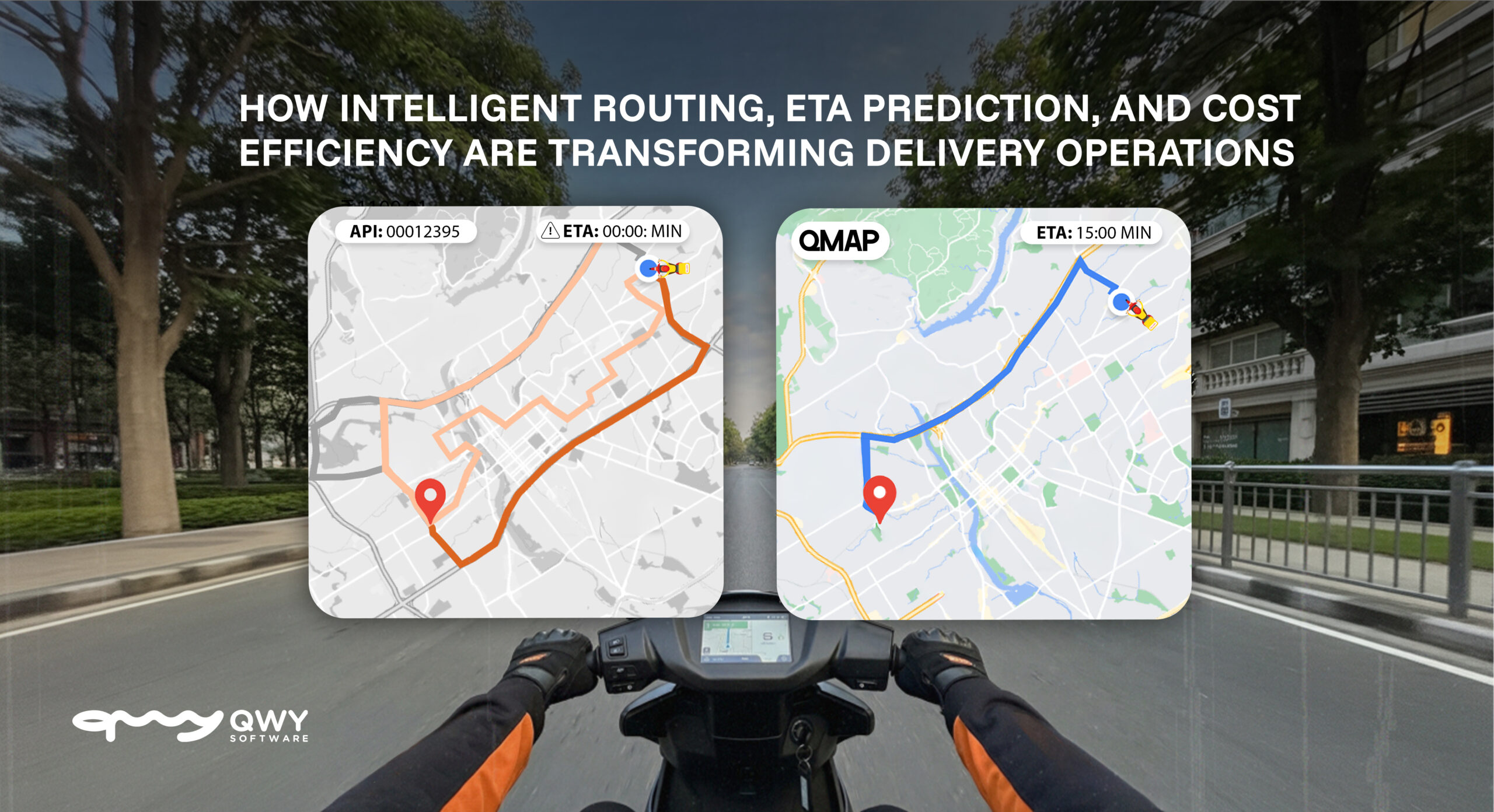
Delivery operations have evolved rapidly over the last decade. What started as a simple “get from point A to point B” problem has become a complex orchestration of speed, accuracy, cost control, and customer experience.
In hyperlocal, logistics, and e-commerce businesses today, speed alone is no longer enough. Customers expect precise ETAs, operations teams demand predictability, and finance teams are under constant pressure to reduce costs without hurting performance.
Yet many delivery platforms still struggle with:
- Inefficient routes
- Unreliable or fluctuating ETAs
- Rising map API costs at scale
This is where QMap comes in, an intelligent routing and ETA engine built to optimize delivery performance without increasing operational costs.
The Current Routing Landscape: Google Maps, Ola Maps, and Where They Fall Short
Most delivery platforms today rely heavily on popular mapping services like Google Maps and Ola Maps and for good reason.
What these tools do well
They excel at:
- Basic navigation
- Shortest-path routing
- Real-time traffic visualization
For everyday navigation, they work well.
Where the gaps begin
However, at delivery scale, cracks start to show:
- High and unpredictable API costs as request volumes grow
- Generic routing logic with no understanding of business constraints
- Limited control over ETA calculation
- Inconsistent accuracy across zones, cities, and time windows
Simply put, these tools are built for drivers, not delivery operations.
Delivery platforms don’t just need navigation, they need routing intelligence.
The New Reality of Delivery Operations
Delivery businesses today operate in a very different environment:
- Order volumes are growing
- Margins are shrinking
- Customer patience is thinner than ever
Customers now expect:
- Live tracking
- Highly accurate ETAs
- Proactive delay communication
At the same time, operations teams are expected to do more with fewer resources, fewer riders, tighter fuel budgets, and leaner support teams.
Traditional routing approaches struggle here because they are:
- Reactive, not predictive
- Traffic-aware, but not business-aware
- Optimized for routes, not outcomes
The Hidden Costs of Traditional Routing Systems
On the surface, routing may look like a technical decision. In reality, it has direct financial consequences.
The real cost drivers include:
- Overdependence on third-party map APIs
- High per-request costs that scale linearly with volume
Inefficient routing leads to:
- Extra travel distance
- Fuel wastage
- Longer delivery times
- More rider fatigue
And inaccurate ETAs?
They quietly increase:
- Customer support tickets
- Reattempts and failed deliveries
- SLA penalties and churn
These are hidden costs, but they add up fast.
What Intelligent Routing Really Means
Intelligent routing isn’t just about finding the shortest path.
It’s about making better routing decisions using:
- Historical delivery data
- Zone-specific behavior
- Time-of-day patterns
- Real-time traffic conditions
Instead of asking,
“What’s the fastest route right now?”
Intelligent routing asks,
“What’s the best route for this delivery, in this zone, at this time, with these constraints?”
This shift, from path-based routing to decision-based routing, is what drives real efficiency.
Introducing QMap: Intelligent Routing Built for Performance and Cost Efficiency
QMap is not another map or navigation tool, it’s a routing intelligence layer designed specifically for modern delivery operations.
Most delivery platforms already use a mapping service for navigation. QMap sits above that layer, adding intelligence that understands how deliveries actually work in the real world. It’s built for high-frequency, high-volume delivery environments where every extra kilometer, minute, or API call impacts cost.
At its core, QMap is designed to balance three things that often compete with each other:
- Faster and more reliable routes
- Consistent, predictable ETAs
- Lower operational cost at scale
Instead of forcing businesses to choose between speed and cost, QMap optimizes for both, continuously and intelligently.
How QMap Optimizes Routes in Real Time
Traditional routing systems react to traffic changes as they happen. QMap goes a step further by combining real-time signals with learned delivery behavior.
One of its key strengths is zonal-based route planning. Rather than treating all roads equally, QMap understands that:
- Certain zones slow down during specific hours
- Some local roads perform better than highways during peak traffic.
- Delivery density changes how riders move through an area
Using this context, QMap dynamically adjusts routes to:
- Avoid congestion before it becomes a problem
- Optimize paths for clusters of deliveries
- Handle multi-stop and batch deliveries more efficiently
The result is fewer unnecessary reroutes, less rider confusion, and smoother end-to-end delivery flows.
Predictive ETA Calculation with QMap
ETA accuracy is one of the hardest problems in delivery and one of the most visible to customers.
QMap treats ETA as a prediction problem, not a simple distance calculation. It learns from:
- Historical delivery data
- Time-of-day and day-of-week patterns
- Zone-level delays and rider behavior
This allows QMap to answer a more important question:
“How long will this delivery actually take in these conditions?”
By producing more reliable ETAs, QMap helps:
- Reduce customer anxiety and complaints
- Prevent reattempts caused by missed time windows
- Improve internal planning and rider allocation
Accurate ETAs don’t just improve customer trust, they stabilize operations.
Cost Efficiency Through Reduced API Dependency
For many delivery platforms, map API costs quietly become one of the largest operational expenses as scale increases.
QMap addresses this by reducing the need for repeated, expensive third-party map calls. It does this by:
- Reusing learned routing intelligence
- Minimizing unnecessary recalculations
- Making smarter decisions before calling external services
As delivery volume grows, QMap helps ensure that costs don’t grow at the same pace.
Beyond cost savings, this also results in:
- Faster system response times
- Improved platform stability
- Better performance during peak traffic periods
It’s cost efficiency built directly into the routing layer.
Operational Benefits for Delivery Teams and Businesses
The real impact of QMap is felt on the ground, by riders, operations teams, and managers.
For delivery riders:
- Routes feel more intuitive
- Fewer last-minute changes
- Less backtracking and confusion
For operations teams:
- Better workload distribution
- Improved planning and shift management
- Fewer escalations due to delays
For businesses:
- Lower fuel consumption
- Reduced manpower strain
- Improved SLA adherence
When routing becomes predictable, operations become calmer and more controllable.
Where QMap Delivers the Most Value
QMap is especially valuable for platforms where delivery complexity increases with scale.
It delivers strong results for:
- Hyperlocal delivery platforms handling dense urban orders
- ONDC-enabled delivery partners managing multiple sellers and zones
- Logistics and fleet-based operations with time-bound deliveries
- E-commerce platforms optimizing last-mile fulfillment
Any business managing high-volume, time-sensitive deliveries can benefit from routing that understands both geography and operations.
Built to Scale Without Cost Explosion
Scaling delivery operations often introduces chaos, more routes, more riders, more complexity.
QMap is built with scale in mind:
- A modular architecture that handles increasing load
- Flexible routing logic adaptable to different business models
- Custom rules without operational overhead
Whether expanding to new cities, adding new delivery types, or onboarding more partners, QMap grows without multiplying complexity or cost.
It’s a system designed not just for today’s volume, but for tomorrow’s growth.
Conclusion: Smarter Routing Leads to Smarter, More Profitable Deliveries
Delivery operations are no longer about speed alone.
They’re about intelligence, predictability, and cost efficiency.
By combining intelligent routing, predictive ETA calculation, and reduced dependency on expensive APIs, QMap becomes more than a routing tool, it becomes a strategic asset.
As delivery ecosystems become more data-driven, platforms that invest in smarter routing today will be the ones that scale profitably tomorrow.