Why Manual Delivery Workflows Are Failing Growing Businesses
Let’s be honest – delivery operations today are far more complex than they were a few years ago.
Customers expect faster deliveries. Businesses operate across multiple channels. Orders flow in from websites, sales teams, B2B portals, and marketplaces. At the same time, companies are trying to control costs, manage drivers efficiently, and ensure accurate billing.
But many growing businesses are still relying on:
- Excel sheets for dispatch
- Phone calls for driver coordination
- Paper-based proof of delivery
- Manual COD reconciliation
- Separate tools for billing and tracking
The result?
- Delayed dispatch
- Lost orders
- Billing errors
- Customer complaints
- Slow cash flow
The truth is simple: disconnected tools and manual processes cannot support modern last-mile and B2B delivery operations.
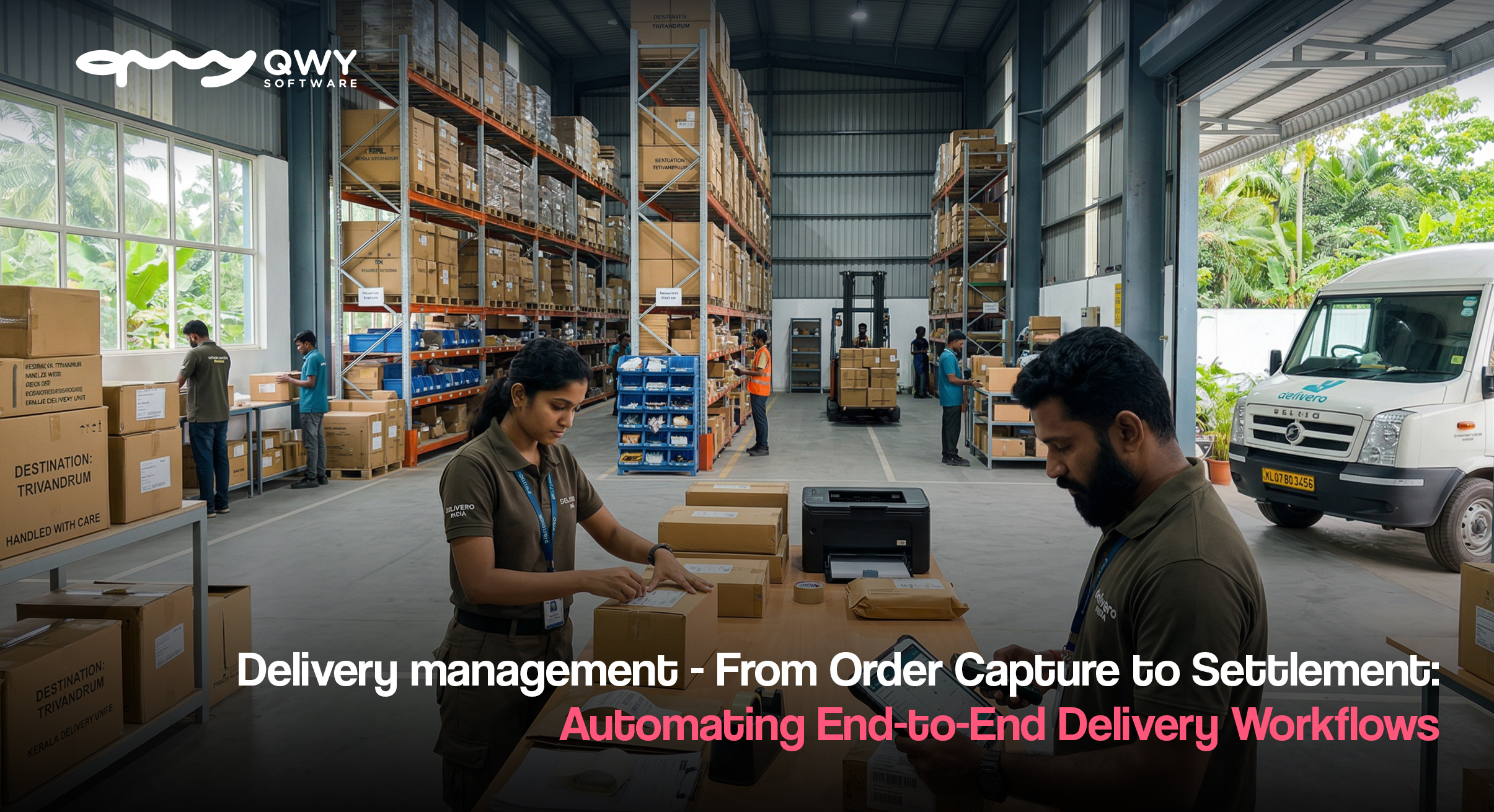
What businesses really need is end-to-end automation, from the moment an order is placed to the moment revenue is settled.
That’s where an ERP-integrated Delivery Management System makes all the difference.
What Is an End-to-End Delivery Workflow?
An end-to-end delivery workflow is not just about assigning drivers and tracking deliveries.
It’s a connected process that includes:
- Order capture
- Order bastching and scheduling
- Driver allocation
- Route optimization
- Live tracking and ETA updates
- Proof of delivery
- COD handling
- Billing and settlement
- Performance analytic
When these stages operate inside a single ERP-driven system, something powerful happens:
There are no data silos.
There is no duplicate entry.
There is no disconnect between operations and accounts.
Everything flows seamlessly.
At QWY Software, we build ERP-integrated delivery automation solutions – primarily powered by Odoo – that connect every step of this workflow into one intelligent system.
Stage 1: Multi-Channel Order Capture & Smart Scheduling
In growing businesses, orders don’t come from just one source.
They may arrive through:
- Company websites
- ERP systems
- Sales representatives
- Marketplaces
- B2B portals
If these channels are not integrated, operations teams waste hours manually consolidating orders.
With an automated delivery management system:
- Orders from all channels are captured in one centralized platform
- Data is automatically validated
- Orders are intelligently grouped (area-wise or time-slot wise)
- Delivery schedules are optimized in advance
This eliminates:
- Manual data entry
- Missed or duplicate orders
- Dispatch confusion
Instead of chasing information, teams focus on execution.
Stage 2: Automated Driver Allocation & Route Optimization
Manual dispatch allocation often depends on guesswork.
Who is available?
Who is closer?
Which vehicle has capacity?
Without real-time visibility, decisions become reactive.
An ERP-powered system automates this process.
Driver allocation can be based on:
- Availability
- Location
- Vehicle capacity
- Delivery priority
Route optimization algorithms reduce:
- Fuel consumption
- Travel time
- Idle hours
The impact is immediate:
- Lower operational costs
- Faster last-mile fulfillment
- Higher driver productivity
And most importantly, scalability becomes possible without increasing administrative overhead.
Stage 3: Real-Time Tracking & Customer Communication
Customers today expect visibility.
They want to know:
- Where is my order?
- When will it arrive?
Without real-time tracking, support teams get flooded with calls.
An integrated delivery system provides:
- Live tracking dashboards
- Accurate ETA prediction
- Automated customer notifications
- Delivery status updates
- Driver mobile app access with navigation and updates
This improves transparency across all stakeholders.
Customers feel confident.
Support teams handle fewer complaints.
Management gets complete operational visibility.
Stage 4: Digital Proof of Delivery (POD)
Paper-based POD creates delays and disputes.
Digital POD transforms this process.
Drivers can instantly capture:
- Electronic signatures
- Delivery images
- Geo-location validation
- Timestamp confirmation
- Delivery remarks
The proof is automatically linked to the trip inside the ERP system.
This means:
- No lost paperwork
- Faster confirmation
- Reduced billing disputes
- Strong audit trail
For businesses handling large volumes, this alone can significantly reduce operational friction.
Stage 5: COD Handling, Billing Integration & Settlement Automation
Cash-on-delivery operations are often the most error-prone part of delivery workflows.
Manual reconciliation leads to:
- Delays in revenue recognition
- Financial discrepancies
- Increased audit pressure
An ERP-integrated system connects delivery completion directly to:
- COD tracking
- Automated reconciliation
- Billing workflows
- Settlement reports
- Exception alerts
When delivery confirmation is linked to invoicing automatically, the revenue cycle becomes faster and more accurate.
Operations and accounts teams work from the same data source – eliminating miscommunication.
Stage 6: Performance Analytics & SLA Monitoring
Automation doesn’t just improve execution – it improves decision-making.
A centralized delivery platform provides insights such as:
- Delivery success rate
- SLA compliance
- Driver productivity metrics
- Cost-per-delivery analysis
- Area-wise performance
Instead of reacting to problems after they escalate, management can proactively optimize operations.
Data becomes a strategic asset.
The Power of ERP Integration in Delivery Automation
Standalone delivery apps may solve one part of the problem – but they rarely integrate deeply with:
- Inventory
- CRM
- Billing
- Finance
- Customer management
This creates fragmented ecosystems.
ERP integration changes everything.
When delivery management is integrated with Odoo ERP:
- Inventory updates in real time
- Billing triggers automatically
- Customer records remain synchronized
- Financial entries are accurate
At QWY Software, we specialize in Odoo implementation, ERP customization, and system integration – ensuring delivery workflows are not isolated tools but part of a unified digital ecosystem.
Business Impact: From Reactive Operations to Predictive Logistics
Here’s what transformation looks like:
Manual Workflow | Automated ERP Workflow |
Delayed dispatch | Instant driver allocation |
Manual COD reconciliation | Automated settlement |
Customer complaints | Real-time visibility |
Paper POD | Digital audit-ready records |
The results are measurable:
- Reduced operational costs
- Faster order-to-cash cycle
- Improved customer trust
- Scalable growth without operational chaos
Why QWY Software for Delivery Workflow Automation?
At QWY Software, we don’t just build software – we design business systems.
Our Delivery Management Solutions offer:
- End-to-end ERP implementation
- Customization for hyperlocal and B2B models
- Scalable architecture
- Intelligent workflow automation
- Real-time reporting dashboards
- Seamless integration across departments
We help businesses move from disconnected operations to intelligent, automated ecosystems.
Conclusion: Future-Ready Delivery Operations Start with Automation
Fragmented systems slow growth.
Manual processes increase errors.
Disconnected tools delay revenue.
But when delivery operations are automated from order capture to settlement – and integrated within a powerful ERP platform – businesses gain control, visibility, and scalability.
If your delivery operations are growing more complex, it may be time to rethink your system.
Looking to automate your delivery operations from order capture to settlement?
Connect with QWY Software for a personalized ERP-powered delivery optimization demo.