Why ERP Customization Needs a Rethink
ERP systems were originally built to standardize processes. The idea was simple: install the software, follow best practices, and scale. But as businesses grew more complex and markets moved faster, that promise started to break down.
Instead of ERP systems adapting to real-world operations, organizations began adjusting their workflows to fit the software. Over time, this created inefficiencies, workarounds, and frustration across teams.
Customization was supposed to solve this problem. Yet traditional ERP customization especially heavy, module-based customization often created more issues than it fixed.
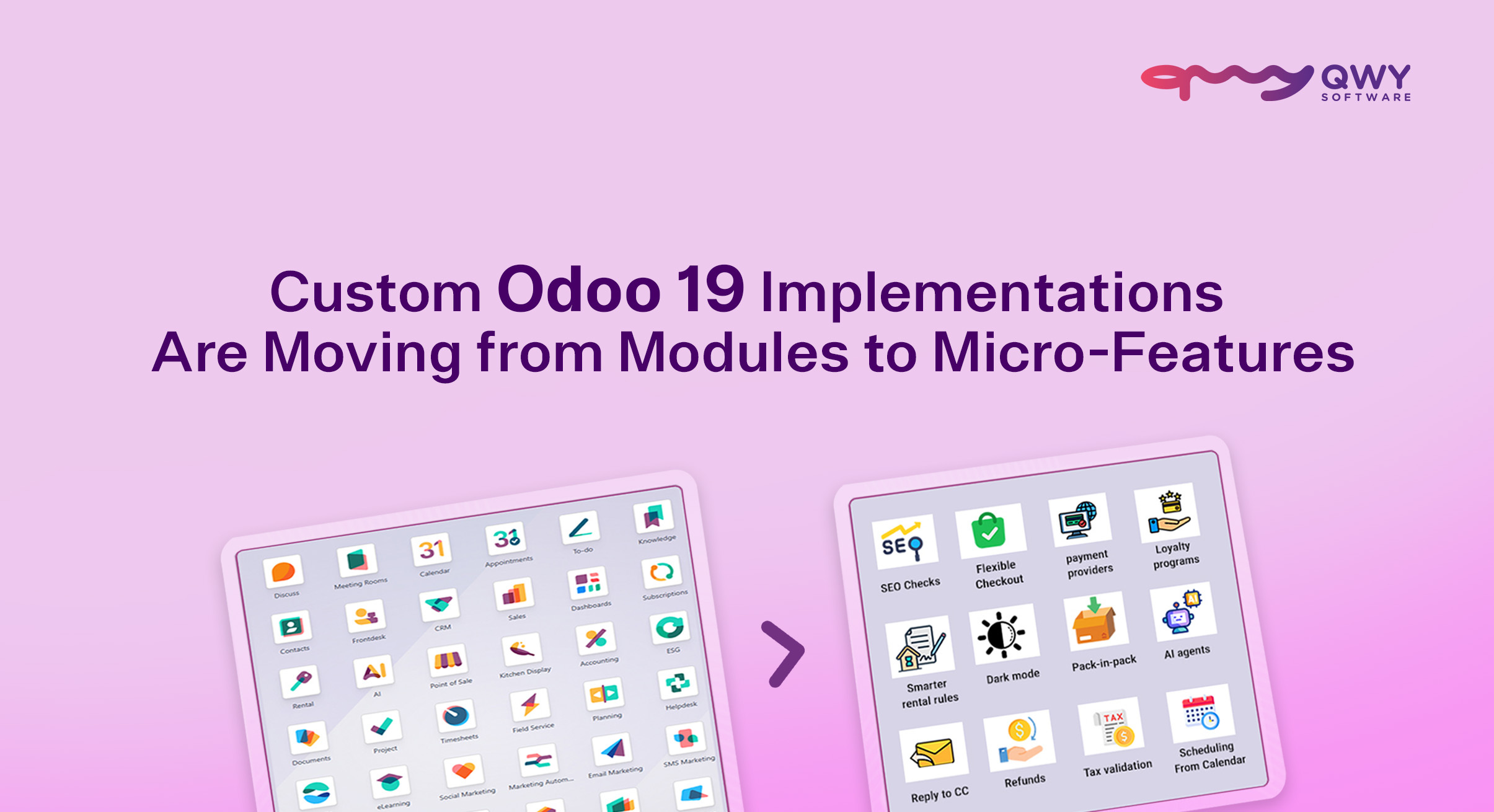
With Odoo 19 Customization, a noticeable shift is happening. Customization is moving away from large, rigid modules and toward micro-features small, targeted enhancements designed around actual business capabilities. This shift represents a more sustainable way to align ERP systems with how organizations truly operate.
Why Traditional ERP Customization No Longer Works
Most ERP platforms are designed around predefined workflows. While these workflows may work on paper, they rarely reflect the nuances of real operations.
As a result, many organizations experience:
- A widening gap between standard ERP functionality and real business processes
- Teams changing how they work just to fit system limitations
- Informal workarounds becoming permanent “shadow processes”
Customization should close this gap. However, when customization itself becomes heavy and inflexible, it simply replaces one problem with another.
The Legacy Problem with Module-Based Odoo Customizations
Historically, Odoo customization meant building full custom modules. These modules often:
- Tightly coupled custom logic with core Odoo models
- Impacted multiple workflows and teams at once
- Required extensive regression testing during upgrades
Initially, this approach felt powerful. Over time, it became a liability. Upgrades were delayed, maintenance costs grew quietly, and agility suffered. Many organizations stayed on older Odoo versions not because they wanted to, but because upgrading felt too risky.
What Are Odoo Micro-Features?
Micro-features represent a shift from “building big” to “building smart.”Instead of creating large modules, micro-features focus on small, specific enhancements that address a single business need:
- Isolated logic with minimal dependencies
- Clearly defined scope and purpose
- Designed around business capabilities rather than technical modules
This approach allows customization to support the business without overwhelming the system.
Common Examples of Odoo Micro-Features
In practical Odoo 19 implementations, micro-features often appear as:
- Conditional approval workflows based on value, risk, or role
- Validation rules enforcing critical business logic
- Role-based UI behavior that simplifies user experience
- Workflow automation triggered by specific events
- Custom reporting elements answering focused business questions
While each change is small, together they significantly improve usability and process alignment.
Why Odoo 19 Enables a Micro-Feature–Driven Approach
This shift is not just a trend it’s enabled by the platform itself.
Odoo 19 introduces:
- Cleaner extension points within the framework
- Better separation between core and custom code
- Improved platform stability for long-term customization
These improvements reduce the need for invasive overrides, making micro-features safer, cleaner, and far more upgrade-friendly.
Why Micro-Features Work Better for Enterprises and Scaling SMEs
For enterprises and fast-growing SMEs, micro-features deliver practical advantages:
- Faster time-to-value through incremental delivery
- Easier maintenance and smoother upgrades
- Reduced disruption when processes change
Most importantly, micro-features evolve alongside the business instead of locking it into rigid structures.
Rethinking Odoo Delivery from a System Integrator’s Perspective
This shift changes how system integrators approach Odoo projects.
Instead of focusing on which modules to build, teams focus on:
- Solving specific business problems
- Delivering measurable improvements quickly
- Maintaining cleaner, easier-to-support codebases
This results in lower long-term support effort and a more sustainable implementation model.
Sales Enablement Value of Micro-Feature–Based Odoo 19 Implementations
From a buyer’s perspective, micro-features offer clearer value:
- Upgrade-safe customization with lower long-term risk
- More predictable implementation and maintenance costs
- A stronger ROI and future-readiness story
For enterprise decision-makers, this approach aligns better with governance, budgeting, and long-term planning.
When Traditional Modules Still Make Sense
Micro-features don’t eliminate the need for modules entirely. Full modules remain appropriate when:
- There are major functional gaps in the core system
- Industry-specific or regulatory requirements apply
- The requirement is broad, stable, and unlikely to change
The difference is that modules are now a deliberate architectural choice, not the default.
How to Decide Between Modules and Micro-Features
A practical way to decide is to ask:
- How complex is the requirement?
- How frequently will it change?
- How strategically important is it to the business?
High-change, workflow-driven requirements are often better served by micro-features.
Conclusion: Odoo 19 Customization Is a Long-Term Architectural Decision
Customization in Odoo 19 is no longer about quick fixes or heavy extensions. It’s about building an ERP system that can grow, adapt, and evolve without accumulating hidden complexity.
Micro-features offer a sustainable path forward one that balances flexibility with stability and innovation with control. They allow businesses to tailor Odoo to real operational needs while keeping upgrades manageable and costs predictable.
Ultimately, the success of an Odoo 19 implementation depends not just on what is customized, but how and why those decisions are made. Choosing the right customization strategy and the right implementation partner can turn Odoo from a system you work around into a system that truly works for you.