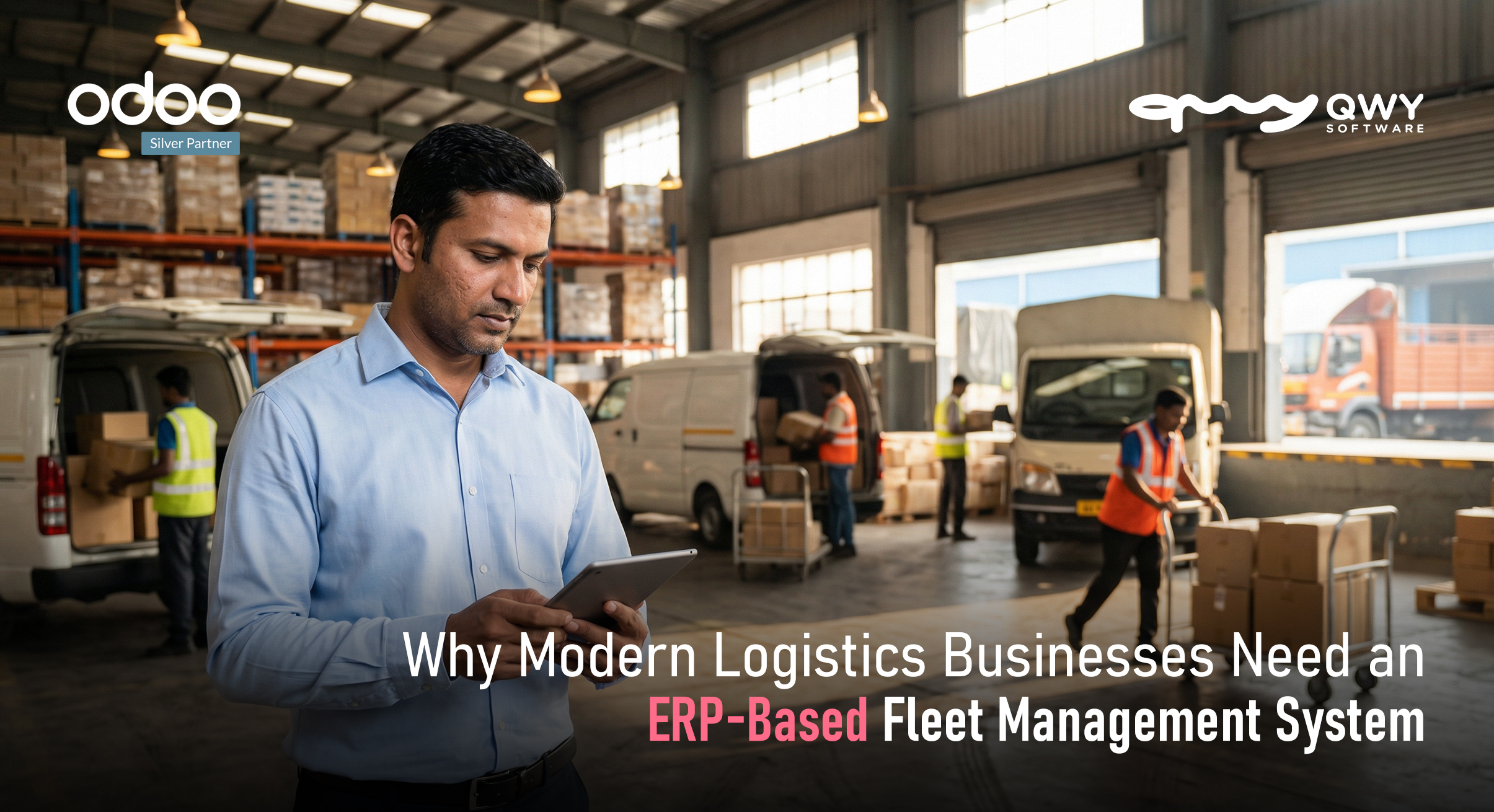
Running a logistics business today isn’t what it used to be.
Fuel costs are unpredictable. Customers expect real-time updates and faster deliveries. Margins are tighter. And on top of that, operations are getting more complex by the day. What once worked with spreadsheets, phone calls and manual logs simply doesn’t scale anymore.
Many fleet operators still rely on disconnected tools – Excel sheets for trip tracking, WhatsApp for communication, separate accounting software for billing and manual processes for vendor payments. It may seem manageable at first, but as operations grow, these gaps start turning into serious bottlenecks.
And that’s where the real difference shows.
The logistics companies that scale smoothly aren’t necessarily the ones with the biggest fleets – they’re the ones with the most connected systems. They have visibility, control and automation across every part of their operations.
This is exactly where an ERP-based Fleet Management System (FMS) comes in – not as just another tool, but as a centralized system that connects your entire logistics workflow.
The Real Cost of Managing Fleets Without a System
At first glance, managing fleets manually might seem cost-effective. But the hidden costs add up quickly – and they show up in places you don’t expect.
Take trip management, for example. When trips are recorded manually, errors are inevitable. A missed entry, a wrong rate, or delayed updates can disrupt the entire billing cycle.
Vendor payments are another pain point. Without a structured system, payments often get delayed or miscalculated. Over time, this affects vendor trust – and in logistics, strong vendor relationships are everything.
Then comes invoicing. Without a digital proof of delivery (POD), disputes become common. Customers question deliveries, finance teams scramble for documentation and payments get delayed.
There’s also the issue of accountability. If a vehicle incident happens, do you have a clear record of what went wrong? Which trip was it linked to? Who was responsible? Without proper tracking, these questions remain unanswered.
And perhaps the biggest challenge – month-end reconciliation.
Finance teams spend days (sometimes weeks) matching trips, invoices and payments. What should be a streamlined process turns into a stressful, error-prone exercise.
All of this isn’t just operational inefficiency – it’s lost revenue, delayed cash flow and limited scalability.
What Is an ERP-Based Fleet Management System?
A Fleet Management System is not a new concept. But not all FMS platforms are built the same.
Most traditional systems focus only on tracking – vehicle location, trip status, maybe basic reporting. While useful, they operate in isolation.
An ERP-based Fleet Management System goes several steps further.
It connects fleet operations with finance, CRM, vendor management and compliance – all within a single platform. Instead of switching between tools, your entire workflow runs on one integrated system.
This means:
- Trip data automatically flows into invoicing
- Vendor payments are linked to completed trips
- Customer interactions are tracked alongside operations
- Compliance processes are built into daily workflows
At QWY, this is exactly how we approach fleet management solutions. Our system is built as part of a broader ERP ecosystem – ensuring that logistics operations are not just tracked, but fully connected and optimized.
Core Capabilities That Modern Logistics Operations Demand
Modern logistics businesses need more than visibility – they need control, automation and accountability. Here’s what that looks like in practice.
Trip Management
Managing trips should be seamless, whether it’s intracity deliveries or long-haul intercity routes. With an ERP-based system, you can create, approve and monitor trips through structured workflows – ensuring nothing falls through the cracks.
Customer & Vendor CRM
Your relationships are just as important as your operations. A built-in CRM helps you manage leads, onboard vendors with approval workflows and handle change requests systematically – without relying on scattered communication.
Digital Proof of Delivery (POD)
Paper-based PODs slow everything down. With WhatsApp-based digital POD, delivery confirmations happen instantly. This not only reduces disputes but also accelerates billing cycles significantly.
Vendor Payment Management
Handling payments manually is risky and time-consuming. With features like bulk payments, advance tracking and NEFT integration, payments become faster, more accurate and fully traceable.
Real-Time Vehicle Tracking
Modern tracking doesn’t need expensive hardware installations. SIM-based tracking provides real-time visibility with minimal setup – making it scalable and cost-efficient.
Incident Reporting
Every incident should be traceable. By linking vehicle incidents directly to trips, businesses gain full accountability and better insights into operational risks.
The Integration Advantage: Why APIs Matter
The real strength of an ERP-based system lies in its ability to integrate with external services.
Instead of manually handling compliance, payments and communication, APIs automate these processes seamlessly.
For example:
- KYC validation becomes instant with GSTIN and PAN verification
- E-invoicing is generated automatically through integrated tax platforms
- Vendor payments are processed via secure banking and payout integrations
- Customers receive real-time updates through WhatsApp and SMS notifications
- Vehicle tracking is powered through SIM-based APIs
The result?
Fewer manual touchpoints. Fewer errors. Faster operations.
In a logistics business where every delay costs money, this level of automation isn’t just helpful – it’s critical.
One System for Intracity and Intercity Operations
One of the most common challenges in logistics is managing different types of operations separately.
Intracity (urban haul) and intercity (FTL/long-haul) operations often run on different processes, pricing models and tools. This creates silos – and silos create inefficiencies.
An ERP-based FMS eliminates this divide.
For urban haul:
- Manage smaller vehicles
- Use vehicle-type-based pricing
- Consolidate invoices easily
For intercity operations:
- Handle trailer-class vehicles
- Manage agreement-based pricing
- Track long-haul workflows with precision
Instead of switching between systems, everything runs on one platform – with workflows tailored to each operation type.
What This Means for Your Business
When your entire logistics operation runs on a connected ERP system, the impact is immediate – and measurable.
Billing cycles become faster because data flows automatically from trips to invoices.
Payment disputes reduce significantly, thanks to digital records and proof of delivery.
Vendor relationships improve, as payments become timely and transparent.
Operations gain real-time accountability, with every trip, vehicle and incident tracked clearly.
And perhaps most importantly – you can scale.
More trips, more customers, more routes – without increasing your administrative workload. Your system grows with your business.
Conclusion
The logistics industry is evolving fast – and technology is no longer optional.
Businesses that continue relying on disconnected tools will find it increasingly difficult to compete. On the other hand, those who invest in integrated, ERP-based systems will gain a clear advantage in efficiency, visibility and scalability.
At its core, an ERP-based Fleet Management System brings everything together – trip management, payments, CRM, tracking and compliance – into one connected ecosystem.
And that’s what enables logistics businesses to move faster, operate smarter and grow sustainably.
If you’re looking to take that step, it might be the right time to explore how QWY’s ERP-driven Fleet Management System can support your operations – or even start with a conversation around what your current process is missing.