No two industries operate the same way. A manufacturing company handles production schedules and quality checks, while a retail business focuses on inventory movement and customer experience. A healthcare provider needs appointment coordination and secure records, while a construction company manages project stages, contractors and material requests.
That is exactly why many businesses struggle with one-size-fits-all ERP systems. Standard software may cover basic functions like sales, accounting, or inventory, but it often falls short when it comes to the day-to-day workflows that make your business unique.
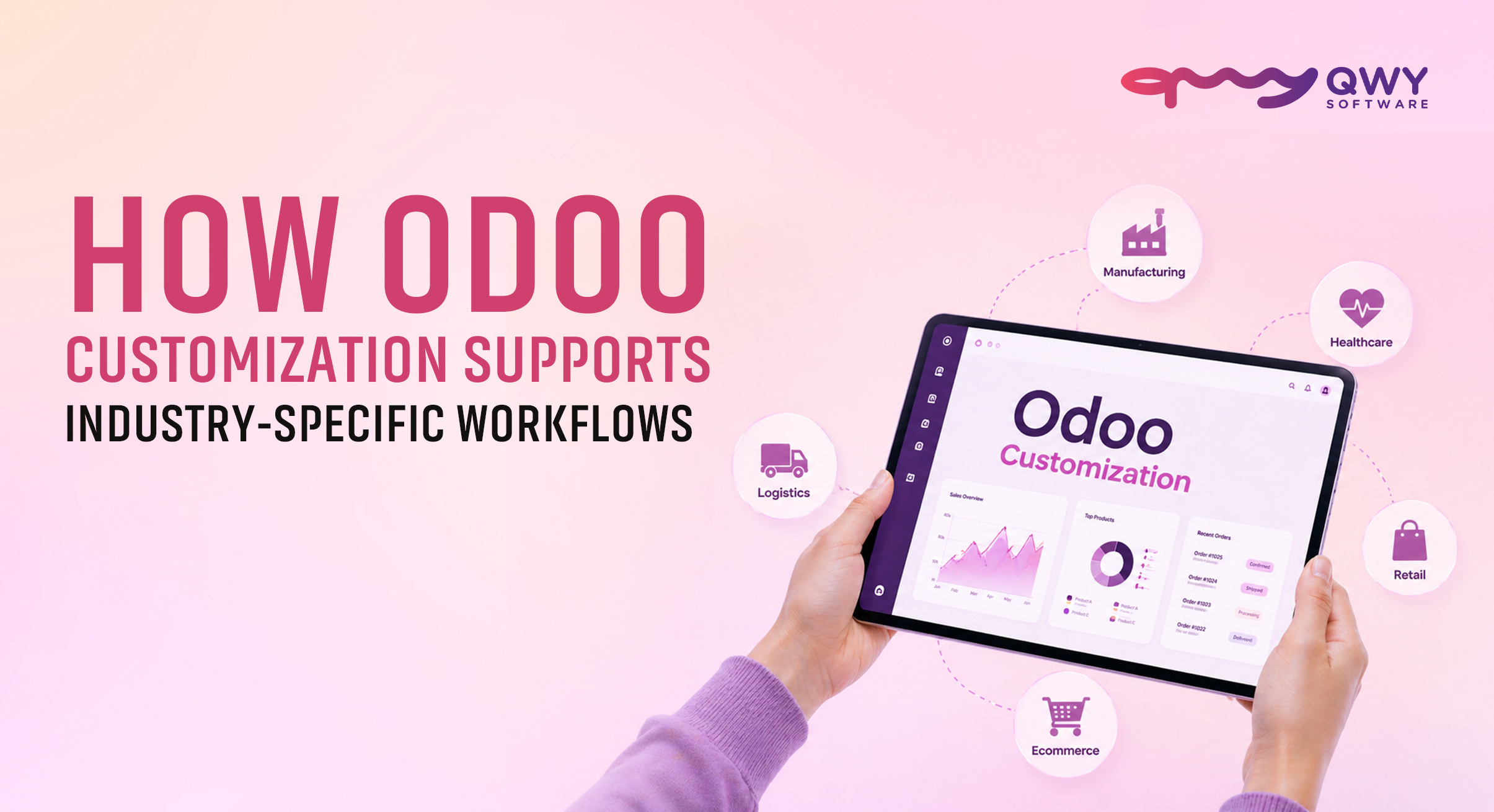
This is where Odoo stands out. Odoo is already known for its flexibility, but its real strength comes through customization. With the right changes, businesses can shape Odoo around how they actually work instead of forcing teams to adapt to rigid software.
QWY Software helps businesses turn Odoo into an industry-ready ERP platform by aligning modules, automation and workflows with real operational needs.
What Are Industry-Specific Workflows?
Industry-specific workflows are the processes, approvals and daily tasks that are unique to a particular sector. These workflows often define how smoothly a business runs.
For example:
- Manufacturing businesses may need production planning, Bill of Materials (BOM) management, machine maintenance schedules and quality checks.
- Retail companies often require POS integration, inventory synchronization across stores, seasonal pricing and loyalty programs.
- Healthcare organizations depend on appointment scheduling, patient record flows, department billing and staff coordination.
- Construction firms manage project milestones, contractor billing, material requests and site progress tracking.
- Education institutions need admissions workflows, student data management, fee tracking and attendance systems.
These are not “extra features.” They are core operational processes. When ERP software does not support them properly, teams are forced to create manual workarounds, use spreadsheets, or rely on disconnected tools.
That usually leads to delays, confusion and missed opportunities.
Why Standard ERP Systems May Fall Short
Standard ERP systems are designed to serve a broad audience, which means they often focus on generic business needs. While that sounds useful, it can become limiting for industries with specialized processes.
Here are some common gaps businesses face:
- Predefined Modules May Not Fit Real Operations
A ready-made workflow might look good in theory but fail in practice. For example, a manufacturer may need multi-stage approvals before production starts, while a service company may need milestone-based invoicing. - Manual Workarounds Increase Errors
When employees need spreadsheets, emails, or extra tools to complete tasks outside the ERP, mistakes happen more often. Duplicate entries and missed updates become common. - Lack of Role-Specific Dashboards
Managers, finance teams, warehouse staff and executives all need different insights. Generic dashboards often overwhelm users with irrelevant data. - Difficult Integrations
Many businesses already use CRM tools, eCommerce platforms, payment systems, or industry software. If ERP systems cannot integrate smoothly, operations remain fragmented. - Limited Reporting
Every industry tracks different KPIs. Standard reports may not show the metrics that truly matter to decision-makers.
How Odoo Customization Solves Industry Challenges
This is where Odoo customization becomes powerful. Instead of changing your operations to fit software, Odoo can be tailored to fit your business.
Custom Modules for Specialized Processes
Businesses can build custom modules that match their exact workflow requirements. This may include new forms, fields, approval stages, document flows, or operational rules.
For example, a healthcare provider can add patient intake workflows, while a construction company can create project cost tracking modules.
Workflow Automation
Repetitive tasks slow teams down. Odoo customization can automate approvals, notifications, task assignments, reminders and status changes.
That means fewer manual follow-ups and faster execution.
Role-Based Dashboards
Different users need different information. Customized dashboards help managers, finance teams, operations staff and executives access the insights relevant to them.
This improves speed and decision-making.
Third-Party Integrations
Odoo can be connected with tools such as:
- CRM systems
- eCommerce platforms
- Payment gateways
- HR software
- IoT devices
- Logistics systems
Instead of switching between tools, teams work through one connected system.
Industry-Specific Reports
Custom reporting allows businesses to track performance using real KPIs rather than generic numbers.
That could mean production efficiency, route performance, patient turnaround time, or project profitability.
Examples of Odoo Customization by Industry
Let’s look at how different sectors benefit from tailored Odoo workflows.
Manufacturing
Manufacturers often customize Odoo for:
- Production planning dashboards
- Machine maintenance scheduling
- Quality control checkpoints
- Raw material consumption tracking
- Multi-stage production workflows
Retail & eCommerce
Retailers commonly need:
- Multi-store inventory synchronization
- Customer loyalty programs
- Online and offline sales integration
- Seasonal pricing rules
- Automated reorder levels
Healthcare
Healthcare providers may customize Odoo with:
- Appointment workflow automation
- Department-wise billing systems
- Staff scheduling tools
- Patient communication workflows
- Secure internal process flows
Logistics & Supply Chain
Supply chain companies often require:
- Route planning workflows
- Delivery tracking integrations
- Vendor performance reporting
- Dispatch coordination systems
- Real-time inventory movement visibility
Service Businesses
Service-based companies benefit from:
- Project milestone tracking
- Resource allocation tools
- Time-based billing automation
- Service request workflows
- Client approval processes
Benefits of Industry-Specific Odoo Customization
When Odoo matches your business operations, the results are noticeable.
- Better Process Efficiency
Employees spend less time adjusting to software and more time completing meaningful work. - Reduced Manual Errors
Automation and connected workflows reduce duplicate data entry and missed steps. - Faster Employee Adoption
Teams are more likely to use systems that reflect how they already work. - Real-Time Visibility
Leaders gain a clearer view of performance across departments. - Improved Customer Experience
Faster service, accurate updates and smoother operations create better customer satisfaction. - Scalability
As the business grows, workflows can evolve without replacing the ERP system. - Competitive Advantage
Businesses that run smarter and faster often outperform competitors still stuck with disconnected systems.
How QWY Software Helps Businesses Customize Odoo
Successful Odoo customization is not just about adding a few extra features or changing screens. It is about understanding how your business operates, identifying bottlenecks and building a system that supports real productivity. The right customization should make work easier, faster and more connected across every department.
QWY Software takes a practical and business-focused approach to Odoo customization. Instead of offering generic solutions, the team studies your workflows, pain points and long-term goals before recommending changes.
QWY Software helps businesses by:
- Analyzing existing workflows and identifying inefficiencies
- Designing industry-specific Odoo modules tailored to business operations
- Automating repetitive tasks such as approvals, notifications, invoicing and reporting
- Integrating Odoo with third-party systems like CRM, eCommerce, HR and payment platforms
- Creating role-based dashboards for better visibility and faster decision-making.
- Providing ongoing support, upgrades, performance improvements and future enhancements.
Whether a business needs minor workflow improvements or advanced custom software solutions, QWY Software helps transform Odoo into a system that truly works for the organization.
Signs Your Business Needs Odoo Customization
Many businesses start with a standard ERP setup, but as operations grow, they often realize the system no longer fits their daily needs. Processes become slower, teams depend on manual workarounds and important data gets scattered across different tools.
If your ERP feels more like an obstacle than a support system, customization may be the next smart step.
Here are some common signs your business needs Odoo customization:
- Teams still rely heavily on spreadsheets outside the ERP for daily tasks
- Repetitive manual processes are consuming time and reducing productivity
- Reports do not reflect the KPIs or insights your management team needs
- Approval workflows are slow, confusing, or handled through emails and calls
- Multiple disconnected tools are being used to complete one process
- Employees avoid using the system because it feels complicated or irrelevant
- Customer requests are delayed due to inefficient internal workflows
- Your business has grown, but the ERP setup has stayed the same
When these issues begin to affect efficiency, customer experience, or decision-making, it is usually a clear sign that your ERP needs to evolve with your business.
Conclusion
Every industry has its own way of operating and businesses perform best when their systems are built around those realities. While standard ERP software can handle basic functions, it often struggles to support specialized workflows, approvals, reporting needs and industry-specific processes.
That is where Odoo customization creates real value. It allows businesses to shape the ERP around how they actually work, helping teams move faster, reduce errors, improve visibility and scale with confidence.
The right customization does more than solve today’s problems. It builds a stronger operational foundation for future growth, automation and digital transformation.
With an experienced partner like QWY Software, businesses can turn Odoo into a fully aligned business platform designed for long-term success, not just another software system.