Digital transformation sounds like something every business should already have figured out. But in reality, many companies are still dealing with disconnected systems, repetitive manual work, scattered data and decisions based on incomplete information.
The problem usually isn’t a lack of technology.
It’s how that technology is connected.
A business might have an ERP system managing its operations, an AI tool generating insights and a separate system handling delivery automation. Each solution may work well on its own, but when they don’t communicate with each other, businesses still end up moving data manually, switching between platforms and making decisions without the full picture.
The real shift happens when three forces work together: ERP that unifies and controls business data, AI that analyzes and predicts and automation that turns decisions into action.
Individually, each one can improve a business. Together, they can fundamentally change how the business operates.
This is where digital transformation becomes more than simply “having new software.” It becomes a connected, intelligent system that can learn, respond and improve over time.
Why Single-Technology Transformation Falls Short
It’s tempting to think that adopting one powerful technology is enough to transform a business. But technology rarely works in isolation.
Take AI, for example.
AI can make impressive predictions and recommendations, but those predictions are only as useful as the data behind them. If business data is scattered across spreadsheets, disconnected applications and outdated systems, AI is working with an incomplete picture.
The same applies to ERP.
An ERP system can bring finance, sales, inventory, HR and operations together. But if employees still have to manually coordinate routine processes around that system, businesses aren’t getting the full value from their ERP investment.
Then there’s delivery automation.
Automating dispatching, routing and tracking can make execution much faster. But without visibility into orders, inventory, customers, costs and other business information, automation can operate without the wider context needed for better decisions.
That’s where the real gap exists.
The problem isn’t the technology. It’s the separation between the technologies.
Digital transformation becomes much more powerful when ERP, AI and automation stop being three separate technology projects and start functioning as one connected system.
The Three Pillars of Modern Digital Transformation
Think of modern digital transformation as a three-layer structure.
ERP provides the foundation. AI provides intelligence. Automation provides execution.
Each layer has a specific role, but the real value comes from how they work together.
1. ERP – The Foundation of Control
Every intelligent system needs reliable information to work from.
That’s where ERP comes in.
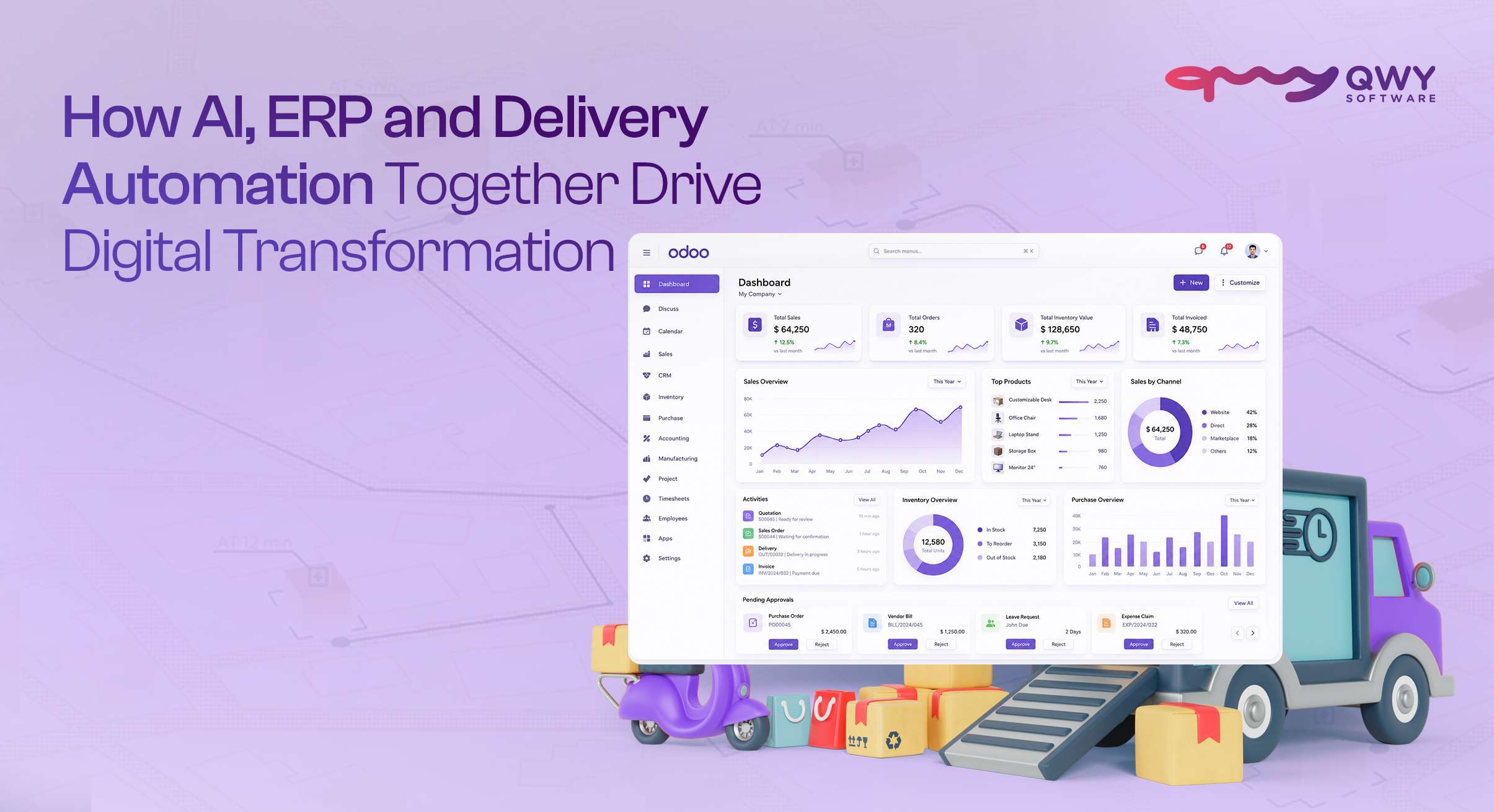
An ERP system brings critical business functions such as finance, sales, inventory, HR, purchasing and operations into a connected environment. Instead of different departments working with different versions of information, everyone works from a shared source of business data.
This creates something extremely important: a single source of truth.
When an order is placed, for example, the information doesn’t need to stay limited to the sales team. It can connect with inventory, finance, operations, customer information and other relevant processes.
That connected foundation becomes essential when businesses want to introduce AI and automation.
Without reliable, centralized data, AI has less context. Without connected processes, automation has fewer opportunities to create meaningful impact.
QWY’s Odoo ERP solutions help businesses create this connected digital foundation by bringing core business processes together and adapting the ERP environment to specific operational requirements.
2. AI – The Intelligence Layer
ERP tells you what is happening.
AI can help you understand what is likely to happen next and what you can do about it.
This is where AI becomes an important layer of digital transformation.
Once business data is centralized and structured, AI can analyze patterns, identify anomalies, generate predictions and support better decisions.
For example, AI can help with:
- Demand forecasting
- Route intelligence
- Resource planning
- Anomaly detection
- Predictive analysis
- Decision recommendations
Instead of simply reacting to what happened yesterday, businesses can start anticipating what may happen tomorrow.
QWY brings this intelligence through its AI/ML engineering capabilities and AI-powered solutions such as QMap, helping businesses move from data collection to intelligent decision-making.
3. Delivery Automation – The Execution Layer
Good decisions only create value when they are acted upon.
That’s where automation comes in.
Delivery automation can take decisions generated by business rules, ERP data, or AI and turn them into actual operational actions.
For example, instead of someone manually assigning every delivery, an automated system can consider available resources, locations, priorities and other relevant factors to make assignments and coordinate execution.
The same principle applies to routing, tracking, notifications and other repetitive processes.
QWY’s Delivery Management System acts as the execution layer, helping businesses automate delivery-related workflows while keeping those processes connected to the wider digital ecosystem.
The result is a simple but powerful structure:
ERP gives the system context. AI gives it intelligence. Automation helps it act.
How the Three Work Together – A Connected Loop
The real magic happens when these three layers communicate continuously.
Think of it as a loop:
ERP captures the data → AI analyzes and decides → automation executes → outcomes return to ERP → AI learns from the results.
And then the cycle starts again.
Consider a simple example.
An order enters an Odoo ERP system. The ERP already knows the order details and relevant business information.
AI can then analyze available information and identify the most suitable route, resources, or delivery option based on the requirements.
The delivery system takes that decision and automatically dispatches the order, while tracking the execution process.
Once the delivery is completed, the resulting data flows back into the broader business system.
That information can then become part of the data used for future analysis and optimization.
The next time a similar order comes in, the system has more information to work with.
This feedback loop is what separates genuine digital transformation from simply having multiple software applications.
Each layer makes the others more useful.
What This Looks Like in Practice – AI-Driven Route Optimization
Route optimization is a good example of what happens when AI and automation move beyond traditional rules.
Traditional routing often depends on static rules and third-party map services. While these tools can be useful, they don’t necessarily understand the complete business context behind every delivery decision.
AI-driven optimization can go further.
It can consider factors such as:
- Real-world conditions
- Multiple delivery stops
- Delivery priorities
- Resource availability
- Distance and travel time
- Cost per trip
- Historical delivery patterns
More importantly, an intelligent system can improve as it processes more data.
This is the thinking behind QMap, QWY’s AI-powered routing engine. Rather than relying entirely on third-party map dependencies, QMap is designed to bring intelligent routing capabilities into the wider technology ecosystem.
By optimizing routes and using the resulting operational data, businesses can work toward reducing unnecessary travel, improving delivery efficiency and controlling costs.
And because the results can feed back into the wider system, route optimization doesn’t have to remain an isolated feature.
It becomes part of a larger digital transformation strategy.
The Business Outcomes of an Integrated Approach
Connecting ERP, AI and automation isn’t just about adding more technology to the business.
The goal is to create measurable operational improvements.
Faster, Smarter Decisions
When real-time business data is combined with AI-driven analysis, decision-making becomes less dependent on assumptions and gut feeling.
Teams can work with current information and data-backed recommendations instead of spending hours collecting and comparing information manually.
Lower Operational Costs
Automation reduces the amount of time employees spend coordinating repetitive processes.
AI can also help optimize resources and identify more efficient ways of working.
Together, they allow businesses to focus human effort where it creates the most value.
Higher Accuracy and Fewer Errors
Disconnected systems often mean the same information gets entered multiple times.
Every additional manual entry creates another opportunity for mistakes.
A connected system reduces unnecessary re-entry by allowing information to move between processes automatically.
Scalability Without Simply Adding More Headcount
Growth shouldn’t mean every operational task needs more people.
When routine workflows are automated, systems can absorb increasing volumes without requiring the same increase in manual effort.
People can focus on exceptions, decisions, customer relationships and higher-value work instead of constantly managing repetitive processes.
Complete Visibility and Control
When business processes, decisions and execution are connected, leadership gets a clearer view of what’s happening across the organization.
Instead of piecing together information from different systems, businesses can work toward having a more unified view of operations.
That visibility makes it easier to identify problems, measure performance and make informed decisions.
Why Most Businesses Struggle to Connect These Layers
On paper, connecting ERP, AI and automation sounds straightforward.
In practice, it can be difficult.
The reason is simple: different vendors often specialize in different parts of the technology stack.
One company provides ERP.
Another provides AI.
Another provides an automation platform.
Another provides a delivery solution.
Businesses then have to connect all of these systems themselves.
And ironically, the attempt to eliminate silos can create another layer of integration complexity.
Data may need to be synchronized between platforms. APIs need to communicate properly. Workflows need to be aligned. Custom integrations have to be maintained.
This is why having a technology partner that understands the complete picture can make a major difference.
QWY brings together Odoo ERP expertise, in-house AI/ML engineering, custom software development and delivery automation capabilities to help businesses build connected technology environments rather than simply adding disconnected tools.
The objective isn’t to bolt technologies together after the fact.
It’s to design them to work together from the beginning.
Industries Being Reshaped by AI + ERP + Automation
The combination of ERP, AI and automation isn’t limited to one type of business.
Different industries can apply the same technology principles to very different workflows.
Logistics and Last-Mile Delivery
Businesses managing complex delivery operations can combine centralized business data, intelligent planning and automated execution to improve visibility and efficiency.
Manufacturing
Manufacturers can connect ERP data with AI-driven forecasting and automated workflows to improve planning, inventory management, production visibility and resource utilization.
Retail and E-Commerce
As order volumes grow, businesses need systems that can connect orders, inventory, customer information, fulfillment and operational workflows.
Distribution and FMCG
High-volume distribution environments can benefit from centralized ERP data, intelligent planning and automation across repetitive processes.
Field Services
Field service businesses can use connected systems to coordinate jobs, resources, schedules, customer information and operational execution more efficiently.
The important point is that the technology stack doesn’t have to look exactly the same for every industry.
The principle stays the same, while the workflows, integrations and AI models can be adapted to the specific needs of the business.
Getting Started – Transformation Is a Journey, Not a Switch
One of the biggest misconceptions about digital transformation is that businesses need to implement everything at once.
They don’t.
In fact, trying to change everything simultaneously can create unnecessary complexity.
A better approach is to build transformation in connected stages.
Start with the foundation.
Bring your core business information and processes together through an ERP platform.
Then automate where the pain is greatest.
Look for repetitive, time-consuming processes that are slowing teams down and introduce automation where it can make an immediate difference.
Then introduce AI where the data supports it.
Once you have reliable, connected data, AI can start generating more meaningful predictions, recommendations and insights.
But there’s one important rule throughout the journey:
Don’t build each layer as a separate project.
Even if you implement them at different times, plan from day one for how they will connect.
That’s where the right technology partner matters.
QWY can help businesses plan a transformation roadmap around their existing processes, technology environment and business goals-then build the required ERP, automation, AI and custom software capabilities so they work together as the business evolves.
Conclusion
Digital transformation isn’t about choosing between AI, ERP, or automation.
It’s about understanding how they complement one another.
ERP provides control and a reliable foundation.
AI adds intelligence to the data.
Automation turns decisions into action.
When these three work together, businesses can move beyond disconnected tools and manual processes toward a system that continuously learns, responds and improves.
The biggest advantage isn’t simply running faster today.
It’s creating an environment where every new piece of data, every completed process and every operational outcome can help the business make better decisions tomorrow.
That’s what meaningful digital transformation looks like.
Ready to move beyond disconnected tools?
QWY Software brings together Odoo ERP, AI/ML engineering, custom software solutions and delivery automation to help businesses build connected systems designed around their unique requirements.
Talk to the QWY team about your digital transformation roadmap and discover how your business can run smarter, not just faster.