Table of Contents
Technology has become an essential part of how businesses manage their daily operations, organize information and serve customers. From handling sales and maintaining inventory to managing employees and tracking business performance, companies increasingly depend on digital tools to keep their operations running smoothly.
Many businesses initially rely on spreadsheets and separate software applications to manage these activities. While these tools may be sufficient during the early stages, managing multiple systems becomes more complicated as the business expands. Data may be scattered across different platforms, employees may need to enter the same information repeatedly and existing software may not support specific operational requirements.
This is where custom software solutions become valuable. Instead of adjusting business processes to fit standard software, companies can develop digital systems designed around their actual workflows, requirements and long-term objectives.
For businesses in Kerala looking to improve operational efficiency and manage growth, investing in the right digital infrastructure can make a significant difference.
What Are Custom Software Solutions?
Custom software solutions are digital applications or systems developed specifically to address the requirements of a particular business. Unlike ready-made software designed for a broad audience, custom-built applications are created around an organization’s processes, operational challenges and objectives.
For example, a manufacturing company may require an application to monitor production activities, manage inventory and track work orders. A healthcare organization might need a patient management portal, while a service-based business may require an employee management system or a customer portal.
Custom software development involves understanding these requirements and creating applications that support the way a business operates.
Some common examples include:
- Customer Portals: Platforms that allow customers to access services, track requests and manage their information.
- Employee Management Systems: Applications for managing employee records, attendance, assignments and internal activities.
- Inventory Applications: Systems that help businesses monitor stock levels, product movements and inventory records.
- ERP Extensions: Additional functionalities developed to support business-specific processes within existing ERP platforms.
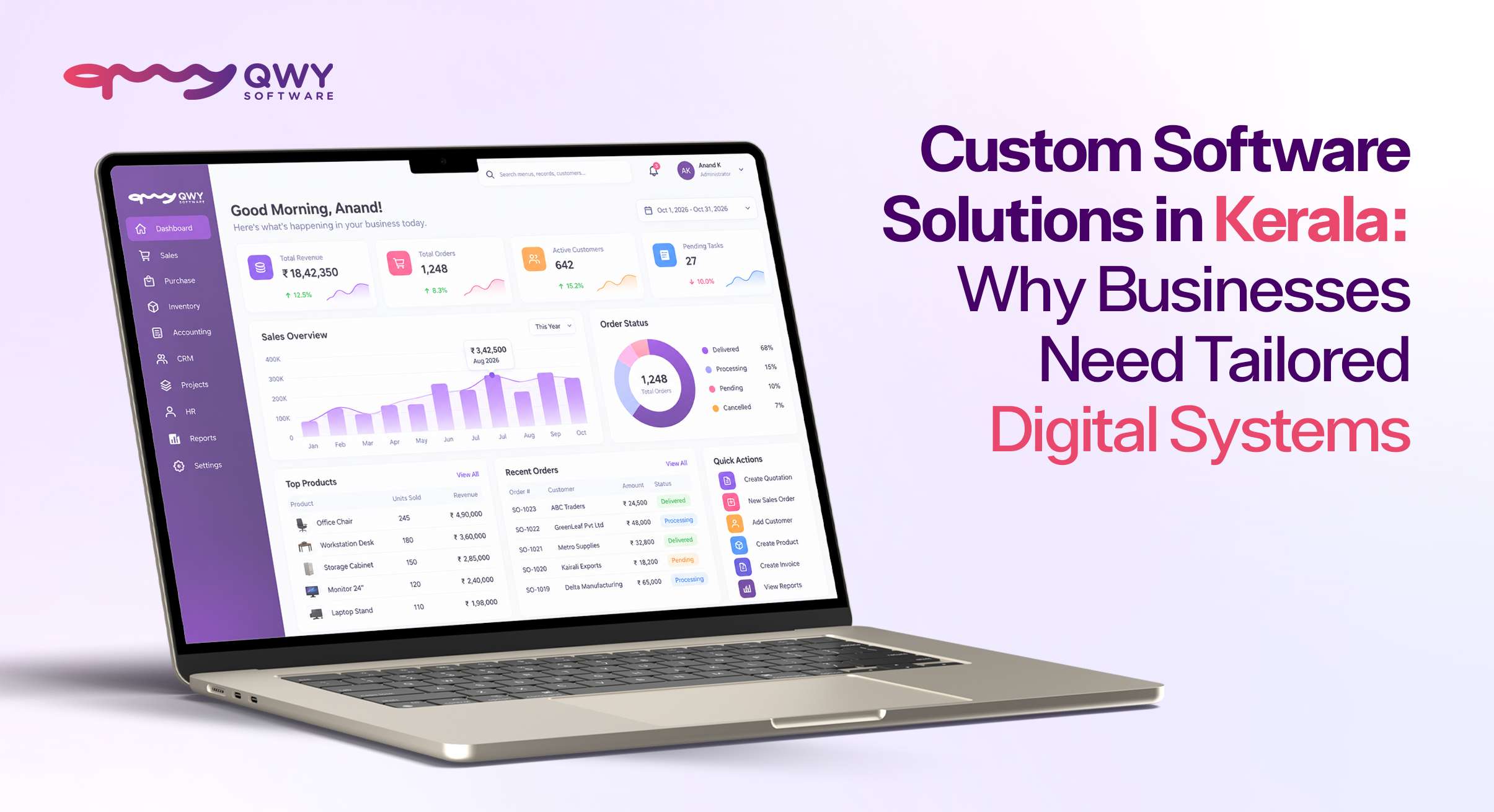
- Reporting Dashboards: Centralized interfaces that display business information and operational performance.
The objective is to create software that supports existing business processes while providing the flexibility to accommodate future requirements.
Why Do Businesses in Kerala Need Tailored Digital Systems?
As businesses grow, their operational requirements become more complex. Managing everything through disconnected applications and manual processes can create inefficiencies. Here are some common challenges that tailored digital systems can help address.
Business Processes Differ from Company to Company
Every business has its own operational structure. A manufacturing company manages production schedules and inventory, whereas a healthcare provider handles patient records and appointments. Similarly, professional services firms manage projects, employee assignments and client communications.
Standard software may not always accommodate these differences.
With custom software solutions, businesses can develop workflows that reflect their actual operational requirements. This allows employees to complete tasks through processes that are relevant to their roles instead of working around unnecessary features or limitations.
Managing Data Across Multiple Systems Is Difficult
Many businesses use separate applications for accounting, customer management, inventory and employee administration. When these platforms operate independently, information becomes scattered.
Employees may need to enter the same details into multiple systems, increasing the possibility of duplicate records and inconsistent information. Accessing updated business data can also become time-consuming.
Integrated software can help centralize information by connecting different business applications. This creates a more organized flow of information and allows relevant teams to access the data they need.
Manual Work Slows Down Business Operations
Repetitive activities such as data entry, approval requests, reporting and record maintenance consume valuable employee time.
For example, when purchase approvals depend entirely on manual communication, requests may remain pending or get overlooked. Similarly, preparing reports by collecting information from different spreadsheets can delay important decisions.
Workflow automation can reduce these repetitive activities by managing task assignments, notifications, approvals and routine processes through a centralized system.
Businesses Need Better Visibility into Performance
Making business decisions without accurate and accessible information can be challenging. When operational data is stored across multiple applications, understanding overall performance requires additional effort.
Centralized dashboards and reporting systems bring relevant information together in one place. Business owners and managers can review operational activities, identify potential issues and understand performance more effectively.
Better visibility also helps decision-makers identify areas that require attention and make informed operational decisions.
Technology Must Support Future Growth
As a business expands, it may add employees, open new branches, introduce services, or modify existing workflows. Software that supports current requirements may become restrictive when these changes occur.
Scalable custom software solutions can be designed to accommodate additional users, increasing data requirements and evolving business processes.
This allows businesses to extend their digital systems as operational needs change rather than immediately replacing their existing technology.
Custom Software vs Ready-Made Software: Which Is Better for Your Business?
Choosing between custom-built and ready-made software depends on the nature of your business, available resources and operational requirements. Both options offer advantages and custom development is not necessarily the right choice for every organization.
|
Factor |
Ready-made software |
Custom software |
|
Initial setup |
Usually quicker |
Requires planning and development |
|
Features |
Based on predefined functionality |
Designed around specific requirements |
|
Customization |
Limited by the product and plan |
Greater control over features and workflows |
|
Integration |
Depends on available integrations |
Can be developed for required integrations |
|
Costs |
Often subscription-based |
Depends on scope, complexity and maintenance |
|
Scalability |
Depends on product capabilities |
Can be designed for anticipated growth |
Ready-made software is generally suitable for businesses with standard requirements that can be addressed through existing features.
However, when existing applications create significant limitations, custom development may be worth considering. The right decision should be based on the actual operational problem rather than choosing a technology simply because it offers more features.
Key Benefits of Custom Software Solutions for Businesses
Investing in the right digital infrastructure can help businesses manage their operations more effectively. Some important benefits include:
- Improved Operational Efficiency: Automating repetitive activities can reduce manual effort and allow employees to focus on more important responsibilities.
- Better Process Control: Software designed around business requirements helps establish structured workflows and responsibilities.
- Seamless System Integration: Connecting different applications can reduce data silos and improve information flow between departments.
- Improved Reporting: Centralized dashboards make business information easier to access, review and analyze.
- Greater Flexibility: Features and workflows can be adapted as business requirements change.
- Enhanced User Experience: Interfaces can be designed around the needs of employees, customers and other users.
- Long-Term Scalability: Additional functionality can be introduced as the organization expands.
The overall value depends on how effectively the software addresses the business’s actual challenges and how well it is maintained over time.
Types of Custom Software Solutions Businesses Can Consider
Different business challenges require different digital applications. Depending on their requirements, organizations can consider several types of software.
Custom Web Applications and Business Portals
Web applications provide a centralized platform for customers, vendors, employees and internal teams to access information and complete tasks. They can simplify communication, service requests, document access and other business activities.
ERP Systems and ERP Extensions
Enterprise Resource Planning (ERP) systems connect important business functions such as sales, finance, inventory, purchasing and human resources.
Platforms such as Odoo ERP can be implemented and customized to support specific business workflows. Additional modules and integrations can extend existing ERP functionality without requiring businesses to manage every process separately.
Workflow Automation Applications
Workflow applications help businesses manage task assignments, approval processes, notifications and repetitive operational activities.
These systems can establish structured processes, reduce manual coordination and improve task visibility across departments.
Custom Mobile Applications
Mobile applications allow employees, customers and field teams to access business services and information conveniently. They can support activities such as field operations, service requests, internal communication and customer engagement.
Reporting Dashboards and AI-Powered Applications
Reporting dashboards bring important business information into a centralized interface. AI-powered applications can further support document processing, information retrieval and AI-assisted insights, helping teams access relevant information and make informed decisions.
How to Know If Your Business Needs Custom Software
Not every operational challenge requires a completely new application. However, certain situations may indicate that your existing technology needs improvement.
Consider the following checklist:
- Employees repeatedly enter the same information into different applications.
- Existing software cannot support important business workflows.
- Manual approvals and reporting delay daily operations.
- Business information is scattered across multiple platforms.
- Available software integrations do not meet your requirements.
- Your business needs specific features that standard applications cannot provide.
- Existing systems are becoming difficult to extend as your organization grows.
If several of these situations apply to your business, it may be worth evaluating your current digital infrastructure.
Sometimes, configuring an existing platform or integrating multiple applications may be sufficient. A new custom application should be considered only when it addresses a clearly identified requirement.
What Should Businesses Consider Before Investing in Custom Software?
Before starting a development project, businesses should evaluate several important factors to ensure that the proposed system meets their requirements.
- Business Requirements: Clearly identify the operational problem the software needs to solve and define the expected outcomes.
- Project Budget: Consider development, hosting, integration, maintenance and future enhancement costs.
- Essential Features: Prioritize necessary functionality instead of adding features that do not contribute to business objectives.
- Integration Requirements: Identify existing ERP, CRM, accounting and other applications that need to connect with the new system.
- Security and Access Control: Establish appropriate data protection measures and user permissions.
- Scalability: Consider future requirements involving additional users, data, branches and functionality.
- Ongoing Support: Ensure that the software can be maintained, updated and improved as business needs evolve.
Evaluating these factors helps businesses establish realistic expectations and make better technology investment decisions.
How Does the Custom Software Development Process Work?
A structured development process helps ensure that the final application addresses the intended business requirements.
- Requirement Analysis: The development team understands business objectives, user expectations, existing workflows and operational challenges.
- Planning and Design: Features, workflows, application architecture and user experience are defined before development begins.
- Development and Integration: The software is built according to the approved requirements and connected with the necessary business applications.
- Testing and Deployment: The application is tested for functionality, security and performance before being introduced into business operations.
- Support and Enhancement: After deployment, ongoing maintenance and improvements help the software remain relevant as business requirements evolve.
Choosing an experienced development partner is important because the quality of requirement analysis, technical implementation and ongoing support directly influences the usefulness of the final application.
Why Choose QWY Software for Custom Software Solutions in Kerala?
Choosing the right technology partner is an important step when planning a digital transformation project. Businesses need a development team that understands their operational requirements and can recommend suitable technology solutions.
QWY Software, based at Technopark, Thiruvananthapuram, Kerala, provides software development and ERP-related services designed to support different business requirements.
The company’s capabilities include:
- Custom Software Development: Developing business applications and digital systems aligned with specific operational workflows.
- Odoo ERP Implementation and Customization: Configuring and extending Odoo ERP to support business processes across different departments.
- System Integration: Connecting existing software applications and business platforms to improve information flow.
- Business Portals and Applications: Developing portals and applications for customers, employees, vendors and internal teams.
- Workflow Automation: Building applications that help manage approvals, task assignments, notifications and repetitive activities.
- Maintenance and Enhancements: Supporting existing applications and improving functionality as business requirements change.
Rather than recommending custom development for every business, QWY Software helps organizations evaluate their requirements and identify an appropriate approach. This could involve developing a new application, integrating existing tools, or configuring an Odoo ERP solution to support specific workflows.
Working with a capable custom software development company can help businesses make informed technology decisions and build digital systems that address practical operational challenges.
Conclusion
As businesses continue to expand, managing operations through disconnected applications, spreadsheets and manual processes can become increasingly difficult. Having the right digital infrastructure helps organizations streamline workflows, integrate business applications, improve reporting and manage growing operational requirements.
Custom software solutions offer businesses the flexibility to develop systems around their actual needs rather than relying entirely on predefined software functionality. However, the right approach depends on the organization’s requirements, existing technology and long-term objectives.
With expertise in custom software development, Odoo ERP implementation, customization and business automation, QWY Software helps businesses identify suitable technology solutions for their operational needs.
Looking to build a digital system that fits your business requirements?
Connect with QWY Software to discuss your software requirements and explore the right digital solution for your business.
Website: https://qwysoft.com/