Not long ago, “fast delivery” meant getting something to a customer by the end of the week. Today, if a customer orders groceries at 4 PM, they expect them at the door before dinner. Same-day is the baseline. Same-hour is quickly becoming the new normal.
That shift is exciting if you run a hyperlocal delivery business. It’s also where a lot of operations quietly start to break.
Because here’s the thing nobody tells you when you’re starting out: the model that works beautifully at 40 orders a day rarely survives at 400. The manual dispatching, the WhatsApp groups full of driver updates, the mental math on who goes where, it all holds together right up until it doesn’t. And when it stops holding, it usually happens on your busiest day, with your most important customers watching.
Technology isn’t the shiny extra here. It’s the thing that decides whether growth feels like momentum or chaos. Let’s talk about why.
Why Scaling Hyperlocal Delivery Is More Challenging Than It Looks
On paper, scaling sounds simple. More orders, more drivers, more revenue. In practice, every new order adds complexity that compounds.
Think about what actually happens as volume climbs. Orders come in faster than anyone can assign them by hand. Someone has to decide which driver takes which delivery and that “someone” is usually a stressed dispatcher juggling a spreadsheet and three phone calls. Drivers double back across the same neighbourhood because nobody planned the routes. Fuel costs creep up. A delivery gets missed, a customer calls to complain and you realize you have no idea where that order even is right now.
The pain points tend to look like this:
- Orders assigned manually, one by one, as fast as a human can type
- Drivers coordinated over calls and messages instead of a system
- Deliveries running late because routing is guesswork
- Fuel and time wasted on inefficient paths
- No live visibility into where anything is
- Customers left in the dark, then frustrated
- Multiple branches or zones that each need their own attention
Individually, none of these is fatal. The problem is that they don’t stay individual. They stack. A missed assignment becomes a late delivery becomes an angry customer becomes a refund becomes a review you’d rather not read. And the higher your volume, the faster that chain reaction fires.
Manual processes don’t scale because human attention doesn’t scale. There are only so many orders a person can track in their head at once – and delivery doesn’t wait for anyone to catch up.
What Technology Really Means for Hyperlocal Delivery Businesses
When people say “just use technology,” they often picture a driver app or a tracking link and stop there. But a single app doesn’t fix a fragmented operation. If your orders live in one place, your drivers in another and your customer updates nowhere at all, you’ve just digitized the chaos.
What actually moves the needle is an integrated system, one platform that connects every stage of the delivery lifecycle so information flows instead of getting stuck.
That means order management and dispatching that talk to each other. Route optimization that feeds directly into the driver’s app. Live tracking that automatically triggers customer updates. Analytics that pull from all of it so you can actually see what’s working. When these pieces are stitched together, the whole operation starts running on rails instead of adrenaline.
This is exactly the gap the QWY Delivery Management System was built to close, a single platform that handles order capture, dispatch, tracking, communication and settlement without you bolting five different tools together. Here’s what that looks like in practice.
Essential Features Every Hyperlocal Delivery Business Needs
You don’t need every feature under the sun. You need the handful that remove the bottlenecks strangling your growth. These are the ones that tend to matter most.
1. Smart Order Management
Everything starts with the order. If capturing and assigning orders is messy, nothing downstream can be clean.
A good system pulls orders in from wherever they originate – your app, your website, a partner platform, a bulk CSV upload, or straight from your CRM or ERP through an API – and lands them all in one dashboard. No copy-pasting between tools. No orders slipping through because they came in on a different channel.
The QWY Delivery Management System centralizes incoming orders across every channel and can batch and schedule them intelligently, so your team stops doing data entry and starts doing actual operations.
2. AI-Powered Route Optimization
This is where a lot of hidden money leaks out. A driver taking a slightly worse route on every single delivery adds up to hours of wasted time and a fuel bill nobody’s watching.
Smart routing looks at your deliveries and figures out the genuinely efficient path, the right sequence for multi-stop runs, the way around traffic, the version that gets more done per trip. QWY’s routing engine identifies those optimal routes automatically, which means faster deliveries and lower running costs without asking your drivers to be logistics experts on top of everything else.
3. Automated Driver Assignment
Manually deciding who takes each order is one of the first things to break under load. The system should just handle it, assigning the nearest available driver, respecting capacity so nobody gets buried and spreading work so it stays balanced.
QWY automates this allocation and it goes a step further with radial re-broadcast: if an order isn’t picked up quickly, it automatically pushes out to nearby available drivers so nothing sits waiting. Geo-fencing keeps assignments inside the right operational zones, so you don’t get orders leaking across boundaries they shouldn’t.
4. Real-Time Delivery Tracking
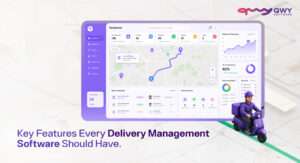
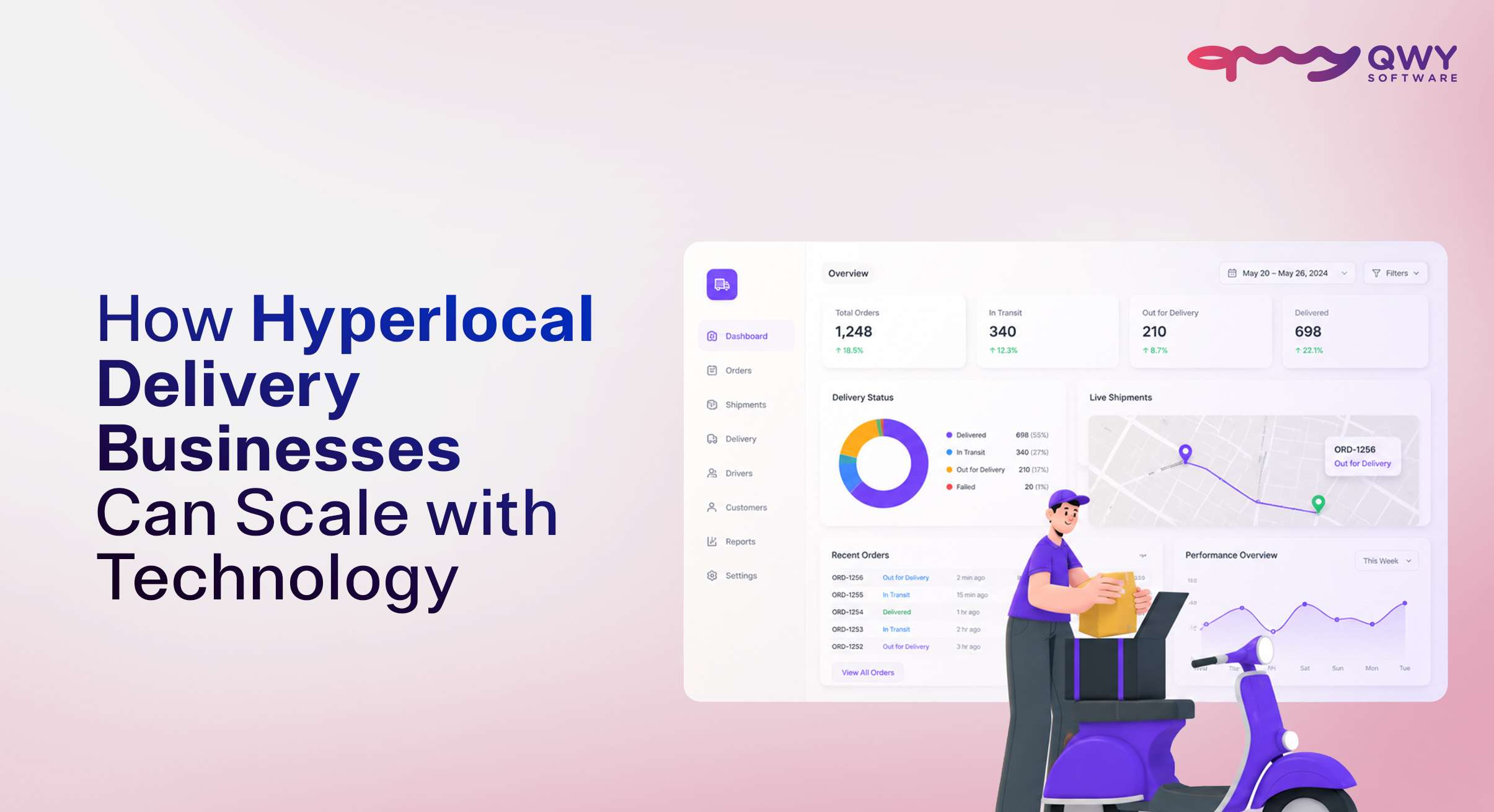
You can’t manage what you can’t see. Live GPS tracking gives your operations team a control-tower view of every driver and every order, with accurate ETAs instead of vague promises.
The QWY tracking dashboard shows the whole picture in real time, including heat maps of where activity is concentrated, so a manager can spot a delay while there’s still time to do something about it, not after the customer has already called.
5. A Driver App That Does the Heavy Lifting
Your drivers are out there doing the hard part. The right app makes their day easier and your data cleaner at the same time.
The QWY Driver App handles navigation, real-time order acceptance and status updates, punch-in/punch-out attendance, OTP verification at handover and digital proof of delivery. It also manages COD collection and payout details, so cash reconciliation stops being a headache at the end of every shift. Everything the driver taps updates the system instantly, which is what makes all that live tracking actually accurate.
6. Automatic Customer Notifications
Half of “bad delivery experiences” aren’t about speed at all. They’re about silence. Customers don’t panic because a delivery is running ten minutes late, they panic because nobody told them.
Automated notifications close that gap. QWY sends real-time updates over WhatsApp, SMS and email as an order moves through its stages, so customers always know what’s happening. Fewer “where’s my order?” calls for your team, a calmer experience for everyone.
7. Analytics and a Business Dashboard
Once the day-to-day runs smoothly, the next unlock is understanding it. A proper analytics layer turns all that operational activity into decisions.
QWY’s dashboards surface the numbers that actually matter, daily delivery volume, success rates, SLA performance, fleet utilization, driver productivity. Instead of guessing why last week felt hard, you can see it. That’s the difference between reacting to problems and getting ahead of them.
How QWY Delivery Management System Helps Businesses Scale
Features are nice, but outcomes are what you’re really buying. Here’s what all of the above adds up to.
- Faster deliveries. Optimized routes and automated dispatch cut the time between “order placed” and “order delivered”, which is the metric your customers judge you on.
- Lower operating costs. Less wasted mileage, less manual coordination, less firefighting. Automation does the repetitive work so your team doesn’t have to.
- Happier customers. Real-time tracking and proactive updates mean people feel informed instead of ignored. That’s what turns a one-time order into a repeat one.
- Better fleet utilization. With smarter routing and assignment, each driver simply gets more done. You grow your delivery capacity without growing your fleet at the same pace.
- Easy expansion. Because operations are standardized in one platform, opening a new zone or a new city doesn’t mean reinventing your process. You replicate what already works.
- Complete visibility. Every order, every driver, every delivery, visible from a single dashboard. No more wondering. You just know.
Industries That Can Benefit from QWY Delivery Management System
Hyperlocal delivery isn’t one industry and the QWY Delivery Management System is built to flex across the ones that live and die by last-mile execution:
- Grocery and supermarkets, where same-day and scheduled slots need tight coordination
- Pharmacies, where speed and accuracy aren’t optional
- Restaurants and food delivery, where minutes genuinely matter
- Fresh produce, where freshness depends on efficient routing
- Furniture and home décor, with larger, scheduled deliveries
- Electronics, where proof of delivery and OTP verification protect high-value goods
- Laundry and water delivery, with recurring, route-heavy runs
- B2B distribution and FMCG, where volume and SLA compliance are everything
The workflows differ, but the underlying need is the same: get more deliveries done, reliably, without drowning in coordination. QWY adapts its dispatch rules, zones and routing to fit how each of these businesses actually operates.
Why Businesses Choose QWY Delivery Management System
When it comes down to the decision, a few things tend to make the difference:
- Intelligent route optimization that pays for itself in fuel and time
- Real-time GPS tracking and a live control-tower dashboard
- Automated dispatching with radial re-broadcast and geo-fence enforcement
- A capable driver app with OTP verification and digital proof of delivery
- SLA definition and monitoring so accountability is built in
- Live delivery analytics for real decisions
- Easy integration with your existing CRM or ERP
- A scalable, secure cloud platform with role-based access control
- Custom workflows that bend to your business, not the other way around
Future-Proofing Your Delivery Operations
Delivery is only getting more demanding. The businesses that will win in the next few years are the ones building on foundations that can grow with them – AI-driven logistics, predictive delivery planning, fully automated dispatch, smart routing and data-driven fleet optimization.
None of that is possible on a manual setup. But it’s a natural next step once your operations run on a platform designed to scale. Investing in that foundation now isn’t about chasing trends. It’s about not being the business scrambling to catch up when customer expectations shift again – because they will.
Conclusion
Scaling a hyperlocal delivery business isn’t just about adding more drivers or more vehicles. You can throw people and trucks at the problem and still end up slower, costlier and more chaotic than before. What actually lets you grow is smarter operations – automated dispatching, intelligent routing, real-time tracking and analytics working together so every new order makes your business stronger, not more fragile.
That’s the whole point of getting the technology right. It lets you grow with confidence instead of holding your breath every busy season.
Looking to streamline your delivery operations? The QWY Delivery Management System helps businesses automate dispatching, optimize routes, track deliveries in real time and scale with confidence. Get in touch with our team to see how QWY can transform your last-mile delivery operations – book a personalized demo and we’ll show you exactly how it fits your workflow.