Delivery is no longer just the final step of an order. For many businesses, it has become one of the biggest parts of the customer experience.
A customer might forget how easy it was to place an order, but they will remember when it arrived late, when they couldn’t track it, or when nobody could tell them where it was.
That is why choosing the right delivery management software matters more than ever.
The challenge is that many businesses choose a system based on its price, feature list, or a quick product demo. The real problems often appear later, when order volumes increase, drivers become harder to coordinate, exceptions start piling up, or the business expands into new locations.
The software isn’t necessarily bad. It may simply be missing the capabilities your operation needs at scale.
So, what should you actually look for?
Let’s look at the key features every delivery management system should have before you make a decision.
Why Choosing the Right Delivery Management Software Matters
Imagine managing 20 deliveries a day. A spreadsheet, phone calls and manual driver assignments might seem manageable.
Now imagine handling 200 or 2,000.
Suddenly, the same process becomes a very different problem.
Your operations team may spend hours assigning drivers. Drivers may sit idle while other areas struggle with capacity. Customers may call repeatedly asking about their orders. Delayed deliveries become harder to identify and management has little visibility into what is happening on the ground.
This is where the real cost of choosing the wrong software starts showing up.
The biggest problem with basic delivery tools is that they can look perfectly fine during a small pilot. They handle the initial orders, show a few dashboards and appear to do the job.
But what happens when your volume grows?
A good delivery management system shouldn’t simply digitize your existing manual process. It should automate, optimize and scale your operations.
The difference between software that grows with your business and software that eventually becomes a bottleneck comes down to the features built into it.
Here are the ones that matter most.
The Core Features Every Delivery Management System Should Have
1. Multi-Channel Order Management
Orders rarely come from one place anymore.
You might receive them through your website, mobile application, marketplace platforms, phone orders, or other sales channels. Managing each channel separately creates unnecessary work and increases the chance of orders being missed.
A good delivery management system should bring these orders into one centralized dashboard.
But simply collecting orders isn’t enough. The system should also help your team batch and schedule deliveries intelligently instead of requiring someone to process every order individually.
QWY Delivery Management System captures orders from multiple channels and automatically batches them, helping businesses manage growing order volumes without letting deliveries slip through the cracks.
2. Automated & Rule-Based Dispatching
Driver assignment can quickly become one of the biggest operational headaches.
Who should take this order? Which driver is closest? Does the driver have enough capacity? Is the order urgent? Does the delivery fall within the driver’s assigned zone?
When these decisions are made manually, your operations team spends valuable time coordinating instead of managing the bigger picture.
With automated dispatching, the system can assign orders to the most suitable available driver based on predefined rules.
These rules can consider factors such as:
- Driver availability
- Capacity
- Order type and weight
- Delivery zone
- Priority
- SLA sensitivity
QWY’s automated routing rules help businesses make these assignments more efficiently. Its radial re-broadcast feature can also re-push unaccepted orders to nearby riders, helping reduce order aging and unnecessary delays.
3. Intelligent Route Optimization
Getting a driver assigned is only part of the job. The next question is: what is the most efficient way to complete the delivery?
Poor route planning can result in unnecessary travel, longer delivery times, higher fuel costs and fewer deliveries completed per driver.
An intelligent routing engine can analyze delivery locations and create more efficient routes, including multi-stop delivery sequencing and traffic-aware route planning.
QWY’s routing engine identifies efficient delivery paths automatically, helping businesses reduce travel time and fuel costs per trip while allowing drivers to complete more deliveries efficiently.
4. Real-Time Tracking & ETA Prediction
Customers don’t want to wonder where their order is.
And your operations team shouldn’t have to call drivers to find out either.
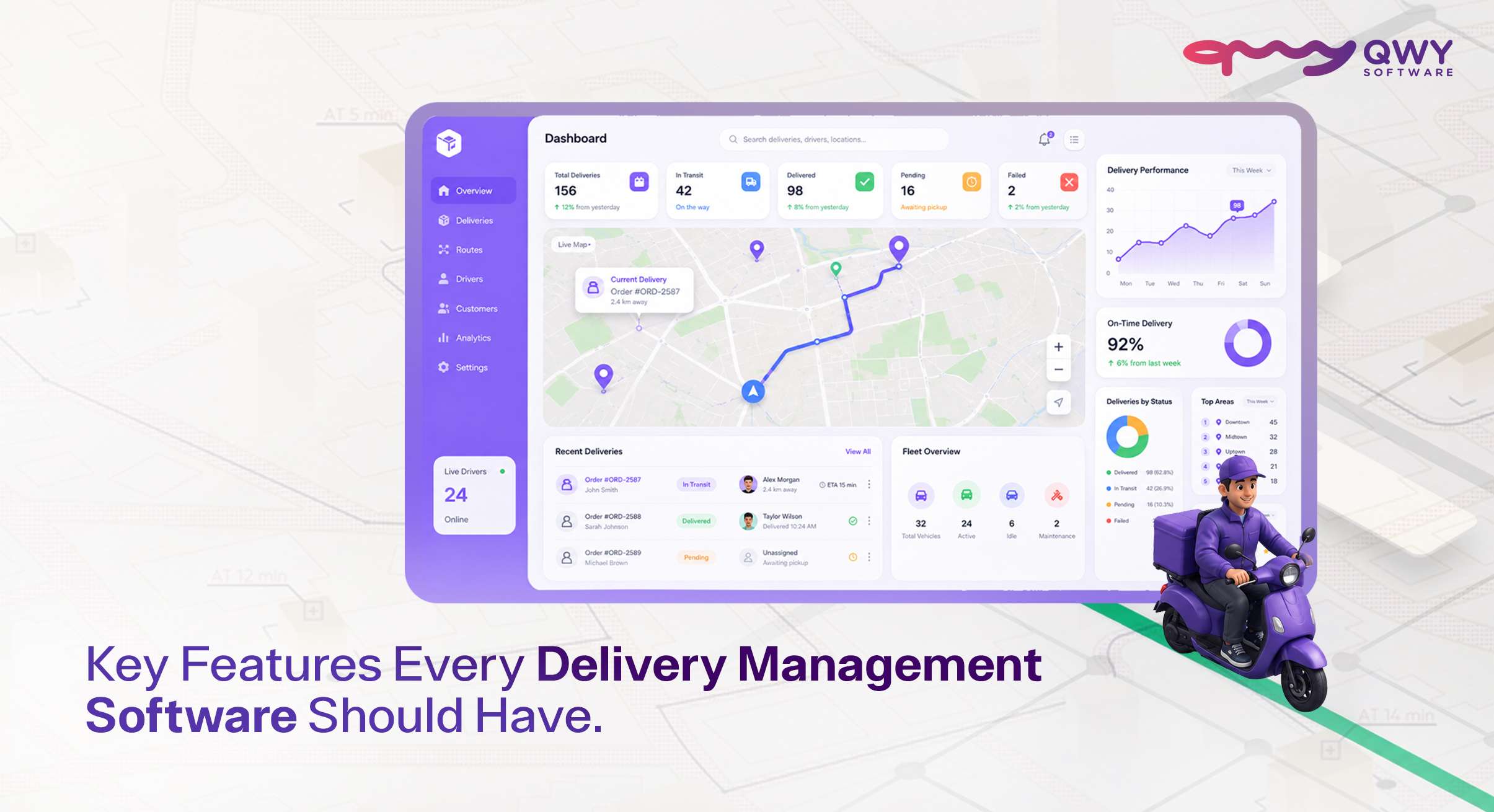
Real-time tracking gives your team visibility into the location and status of deliveries from a central dashboard. More importantly, ETA prediction helps turn location data into something useful.
Instead of simply knowing where a driver is, your team can understand when the delivery is likely to arrive and identify potential delays earlier.
QWY provides a live tracking dashboard with ETA prediction, giving operations teams better visibility across their delivery network.
5. Driver Mobile App
The driver is the person actually executing the delivery, so the software they use needs to work in the real world, not just inside an office.
A good driver app should give drivers access to everything they need during a delivery, including:
- Navigation
- Order and delivery details
- Delivery status updates
- OTP verification
- Digital proof of delivery
- Offline functionality
Offline capability is particularly important in areas with poor network connectivity. Drivers shouldn’t lose critical information just because the internet connection drops temporarily.
The QWY Driver App supports offline capability, allowing delivery operations to continue even in low-signal areas.
6. Automated Customer Notifications
One of the most common customer questions is simple:
“Where is my order?”
Without automated communication, your support team ends up answering the same question repeatedly.
A delivery management system can eliminate much of this unnecessary communication by automatically notifying customers as their order progresses.
Notifications can be sent through channels such as:
- SMS
Customers can receive updates at important stages of the delivery journey, giving them better visibility without needing to contact your support team.
QWY’s automated notification flows help businesses keep customers informed throughout the delivery process and reduce unnecessary “where’s my order?” calls.
7. COD, Billing & Settlement Handling
For businesses that handle cash on delivery, completing the delivery is only half the process.
The money collected also needs to be tracked, reconciled and settled correctly.
Without proper COD management, finance and operations teams may have to depend on spreadsheets or manual reconciliation. As delivery volumes grow, this becomes increasingly difficult to manage accurately.
A robust delivery management system should therefore support COD handling, billing integration and settlement reporting as part of the operational workflow.
QWY includes COD handling and settlement reporting, helping businesses maintain better control over one of the areas that cheaper delivery tools often overlook.
8. Analytics & SLA Monitoring
You can’t improve what you can’t measure.
A good delivery management system should give you more than a basic list of completed orders. It should help you understand how the entire operation is performing.
Useful metrics can include:
- Delivery success rate
- Fleet utilization
- Driver performance
- SLA breaches
- Revenue insights
- Delivery turnaround time
Real-time SLA monitoring is particularly valuable. Instead of discovering a breach after the delivery is already late, operations teams can see countdowns and receive alerts when an order is at risk.
QWY combines performance analytics with real-time SLA countdowns and breach alerts, giving teams the information they need to respond before small delays become larger operational problems.
The Advanced Features That Separate Enterprise-Grade from Basic Software
Core features help you manage deliveries. Advanced capabilities help you manage complexity at scale.
This is where enterprise-grade delivery management software starts to stand apart from basic tools.
Geo-Fence Enforcement
Delivery operations often need to follow specific geographic boundaries.
Geo-fencing can ensure that orders are created, assigned and executed only within defined zones. This helps prevent cross-zone leakage and keeps operations aligned with your delivery network.
SLA Definition & Monitoring
Different orders may have different delivery commitments.
A flexible system should allow businesses to define pickup and delivery SLAs based on their operational requirements and monitor them in real time.
Countdowns and breach alerts give teams the opportunity to act before an SLA is missed.
Drag-and-Drop Dispatch
Automation should not mean losing control.
During peak periods or unusual situations, operations teams may need to manually override an automated assignment.
A drag-and-drop dispatch interface gives teams that flexibility while keeping the overall operation centralized.
Rider Inactivity Escalation & Auto-Blacklisting
Fleet performance can be affected by inactive or non-compliant riders.
Instead of relying entirely on supervisors to identify these issues, the system can flag inactivity automatically and escalate or blacklist riders based on predefined rules.
This helps maintain better fleet health as the number of drivers increases.
Peak Pricing & Payout Engine
Delivery costs can change depending on demand, location and time of day.
A peak pricing and payout engine allows businesses to configure delivery fees and driver payouts based on these factors.
This provides more flexibility when managing high-demand periods and different operating zones.
Third-Party Logistics Integration
Not every delivery needs to be handled by an in-house fleet.
Businesses may work with third-party logistics partners when they need additional capacity or want to expand their reach.
Third-party logistics integration allows businesses to combine in-house riders with external delivery partners while maintaining centralized operational visibility.
Role-Based Governance
As operations grow, not everyone should have access to everything.
Admin, operations, finance and enterprise users may each require different levels of access.
Role-based governance helps businesses control permissions while maintaining structured workflows and audit trails.
Basic software gets an order from A to B. Enterprise-grade software keeps that process reliable when the volume, complexity and number of exceptions increase.
This is often the layer businesses discover they need only after they’ve already outgrown their first delivery tool.
How QWY Delivery Management System Brings It All Together
The value of delivery management software isn’t really about how many features appear on a product page.
It’s about what those features do for your day-to-day operation.
With the right system in place, businesses can achieve:
- Faster deliveries
Automated dispatching and optimized routes help reduce unnecessary delays and travel time. - Lower operational costs
Less manual coordination, better fleet utilization and more efficient routes can help control operating costs. - Higher customer satisfaction
Real-time tracking and proactive notifications give customers better visibility throughout the delivery journey. - More deliveries per driver
Better route planning and automated assignment can help drivers handle more deliveries without requiring the same increase in headcount. - Effortless expansion
Standardized delivery workflows make it easier to expand operations into new cities and zones. - Complete visibility
Orders, drivers, delivery status, performance and exceptions can be managed from a centralized dashboard.
The result is not just better delivery tracking. It is a more structured and scalable delivery operation.
Industries That Rely on Delivery Management Software
Delivery requirements vary significantly from one industry to another.
A grocery business may need to manage high order volumes and time-sensitive deliveries. A pharmacy may have different requirements around delivery priorities and compliance. A furniture business may need to coordinate larger items and different delivery workflows.
Delivery management software can support businesses across industries such as:
- Grocery and supermarkets
- Pharmacies
- Restaurants
- Fresh produce
- Furniture and electronics
- Laundry
- Water delivery
- B2B distribution
- FMCG
The important part is flexibility.
QWY Delivery Management System can be adapted to different industry-specific workflows and operational requirements, helping businesses build delivery processes around the way they actually work rather than forcing every operation into the same model.
How to Evaluate Delivery Management Software Before You Buy
Choosing delivery software shouldn’t come down to checking the number of features on a brochure.
Before making a decision, ask a few practical questions.
Does it automate dispatching, or does it simply digitize a manual process?
If your team still needs to spend hours assigning drivers manually, you’re not getting the full benefit of automation.
Can it handle exceptions?
Real operations aren’t perfect. Pickups fail. Drivers become inactive. Orders get delayed. Zones get breached.
Your system should help identify and manage these situations instead of leaving your team to solve everything manually.
Can it scale from one city to many?
A system that works for one location may not necessarily work for a multi-city operation. Make sure the software can support expansion without requiring an entirely new implementation.
Does it integrate with your existing ERP and billing systems?
Your delivery operation shouldn’t exist in isolation. Integration with your existing business systems can reduce duplicate data entry and create a more connected workflow.
Are the analytics real-time and actionable?
Reports are useful, but real-time operational insights are much more valuable when teams need to make decisions quickly.
QWY Delivery Management System is designed around these requirements, bringing together automated dispatching, intelligent routing, live tracking, driver management, notifications, settlement handling, analytics and advanced operational controls in one platform.
Conclusion
The right delivery management software isn’t necessarily the one with the longest feature list.
It’s the one that helps your team automate dispatching, optimize routes, track deliveries in real time, manage exceptions, monitor performance and continue operating efficiently as order volumes grow.
A system that works at 20 deliveries a day is easy to find.
The real question is whether it will still work when you’re handling 200, 2,000, or multiple cities.
That’s where choosing the right capabilities from the beginning makes a difference.
Looking for delivery software built to scale? QWY Delivery Management System helps automate dispatching, optimize routes, track deliveries in real time and give your team complete operational visibility.
Talk to the QWY team for a personalized demo and see how the platform can fit your delivery operations.