Running a business today is more challenging than ever. As companies grow, so do their processes, teams, customers and operational requirements. What once worked with spreadsheets, emails and separate software tools often becomes inefficient and difficult to manage.
Many businesses don’t realize they’re losing valuable time and money because of manual processes. Employees spend hours entering the same data into multiple systems, departments struggle to stay aligned and decision-makers lack real-time insights needed for growth.
This is where ERP automation comes in.
Enterprise Resource Planning (ERP) systems help businesses streamline operations by connecting different departments and automating repetitive tasks. Among the many ERP solutions available, Odoo ERP has become a popular choice for businesses looking for flexibility, scalability and cost-effective automation.
In this article, we’ll explore the most common signs that indicate your business is ready for Odoo ERP automation and how implementing the right ERP solution can transform the way you work.
Understanding ERP Automation: What Does It Mean?
ERP automation refers to the use of integrated software to automate and manage business processes across different departments. Instead of using separate systems for sales, inventory, accounting, HR and customer management, an ERP platform brings everything together in one centralized system.
Think of it as the digital backbone of your organization.
With ERP automation, information flows seamlessly between departments. When a sales order is created, inventory updates automatically. When products are shipped, invoices can be generated instantly. When payments are received, accounting records are updated without manual intervention.
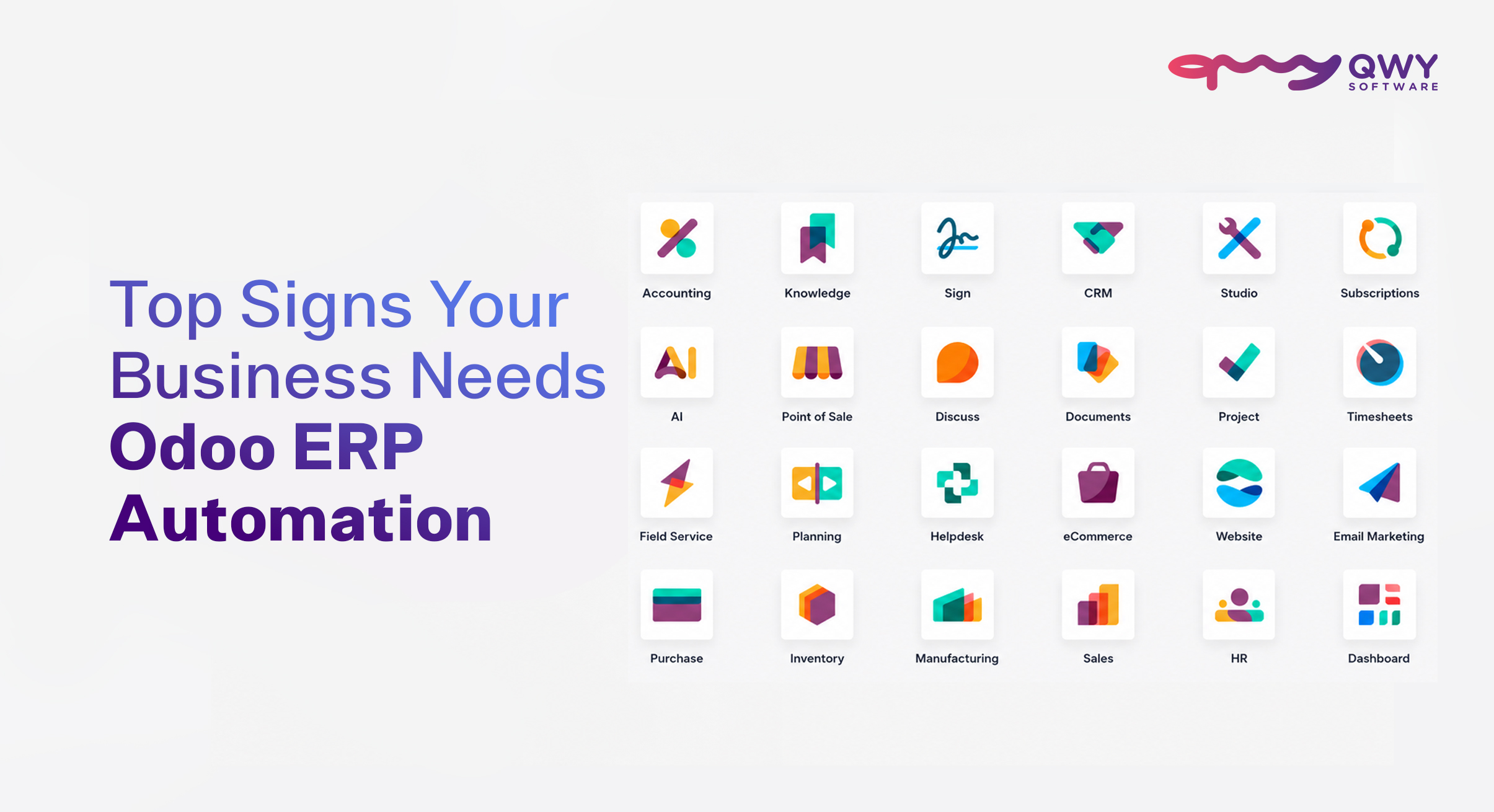
Odoo ERP can automate a wide range of business functions, including:
- Sales Management
- Customer Relationship
- Management (CRM)
- Inventory Management
- Purchasing
- Accounting and Finance
- Human Resources
- Manufacturing
- Project Management
- Customer Support
Sign #1: Your Team Is Spending Too Much Time on Manual Data Entry
One of the clearest signs that your business needs ERP automation is excessive manual data entry.
Many organizations still rely on employees to transfer information between spreadsheets, accounting software, CRM systems and inventory platforms. Not only is this time-consuming, but it also increases the likelihood of human error.
Imagine your sales team entering customer information into one system while your finance team manually updates invoices in another. Every duplicated task adds unnecessary workload and creates opportunities for mistakes.
How Odoo Helps
Odoo eliminates repetitive data entry by connecting all business processes within a single platform.
For example:
- Customer details entered by the sales team automatically become available to finance and support teams.
- Sales orders update inventory levels instantly.
- Invoices are generated automatically based on completed transactions.
Sign #2: Departments Are Working in Silos
As businesses grow, departments often become disconnected.
Sales teams may not have visibility into inventory levels. Finance teams may struggle to access customer information. Operations teams may rely on outdated reports to make decisions.
These communication gaps create delays, confusion and inefficiencies.
When departments work in isolation, customer service suffers and business performance declines.
How Odoo Helps
Odoo provides a centralized platform where every department works from the same data source.
This means:
- Sales can check inventory in real time.
- Finance can track customer transactions instantly.
- Management can monitor overall business performance through a single dashboard.
Sign #3: Inventory Management Is Becoming Difficult
Inventory challenges are one of the biggest indicators that a business has outgrown manual processes.
Common inventory problems include:
- Frequent stock shortages
- Overstocking of slow-moving products
- Incorrect inventory counts
- Delayed stock updates
- Warehouse inefficiencies
How Odoo Helps
Odoo Inventory Management provides real-time stock visibility across warehouses and locations. Key benefits include:- Automated inventory tracking
- Low-stock alerts
- Automatic replenishment rules
- Barcode integration
- Warehouse optimization tools
Sign #4: You Struggle to Generate Accurate Business Reports
If creating business reports feels like a monthly headache, it’s probably time to automate.
Many businesses still compile reports manually by gathering data from multiple systems.
This process is often slow, labor-intensive and prone to errors.
By the time reports are completed, the information may already be outdated.
Without accurate reporting, decision-making becomes reactive instead of strategic.
How Odoo Helps
Odoo offers built-in dashboards and reporting tools that provide real-time insights into business performance.
You can instantly access:
- Sales reports
- Financial reports
- Inventory reports
- Project performance metrics
- Employee productivity data
Sign #5: Customer Follow-Ups Are Being Missed
Customer relationships are critical to business success.
However, many companies struggle to manage leads, follow-ups and customer communications effectively.
Signs of poor customer follow-up include:
- Unanswered inquiries
- Missed sales opportunities
- Delayed responses
- Lost leads
- Inconsistent customer communication
How Odoo Helps
Odoo CRM automates lead management and customer communication workflows. Features include:- Automated lead assignment
- Follow-up reminders
- Sales pipeline tracking
- Activity scheduling
- Email automation
Sign #6: Order Processing Takes Longer Than It Should
Slow order processing can negatively impact customer satisfaction and operational efficiency.
Many businesses still rely on manual approval processes and disconnected systems to handle orders.
This often results in:
- Processing delays
- Order errors
- Shipping issues
- Customer complaints
How Odoo Helps
Odoo streamlines the entire order-to-delivery process. When an order is placed:- Inventory is checked automatically.
- Stock levels are updated instantly.
- Invoices can be generated automatically.
- Shipping processes are triggered without manual intervention.
Sign #7: Financial Processes Are Becoming Hard to Manage
As your business grows, financial management becomes increasingly complex. What may have worked with basic accounting software or spreadsheets can quickly become overwhelming when dealing with larger transaction volumes, multiple payment methods, vendor payments, tax compliance and financial reporting.
Some common warning signs include:
- Delayed invoice generation
- Difficulty tracking payments and outstanding balances
- Frequent reconciliation issues
- Errors in financial records
- Lack of visibility into cash flow
How Odoo Helps
Odoo Accounting automates many of the repetitive financial tasks that businesses struggle with daily. With Odoo, you can:- Generate invoices automatically
- Track payments in real time
- Automate bank reconciliations
- Manage vendor bills efficiently
- Access up-to-date financial reports anytime
Sign #8: Business Growth Is Creating Operational Bottlenecks
Growth is exciting, but it often exposes weaknesses in existing systems.
As customer orders increase, product catalogs expand and teams grow, manual processes become harder to manage. What worked for a small business may no longer support a growing organization.
You may notice:
- Delays in approvals
- Increased operational errors
- Employee workload becoming unmanageable
- Difficulty maintaining service quality
- Rising operational costs
How Odoo Helps
One of the biggest advantages of Odoo ERP is its scalability. Businesses can start with the modules they need today and add more functionality as requirements evolve. Whether you’re expanding into new markets, opening additional locations, or increasing production capacity, Odoo grows with your business. Its modular structure allows organizations to scale without constantly switching software platforms.Sign #9: You Lack Real-Time Visibility Into Business Performance
Many business leaders make decisions based on reports that are days or even weeks old.
The problem with outdated information is simple: it doesn’t reflect what’s happening right now.
Without real-time visibility, businesses often struggle to:
- Monitor sales performance
- Track inventory levels
- Measure employee productivity
- Identify operational issues
- Forecast future growth accurately
How Odoo Helps
Odoo provides live dashboards and real-time reporting across all business functions. Managers can instantly view:- Sales performance
- Revenue trends
- Inventory movements
- Project progress
- Customer activities
- Financial health
Sign #10: Multiple Software Tools Are Increasing Costs and Complexity
Many organizations use separate software for:
- CRM
- Accounting
- Inventory Management
- HR
- Project Management
- Customer Support
- E-commerce
- High subscription costs
- Data duplication
- Integration issues
- Employee training difficulties
- Inconsistent reporting
How Odoo Helps
Odoo offers a unified ecosystem where all business functions work together seamlessly. Instead of paying for multiple disconnected platforms, businesses can manage operations through a single integrated solution. Benefits include:- Lower software costs
- Better user experience
- Improved collaboration
- Consistent business data
- Simplified system management
The Business Impact of Delaying ERP Automation Many businesses recognize operational inefficiencies but postpone ERP implementation because they believe their current processes are “good enough.”
Unfortunately, the cost of waiting often increases over time.
Hidden Costs of Manual Operations
Manual processes consume employee time that could be spent on higher-value activities. Small inefficiencies may seem manageable individually, but they add up significantly across departments.
Productivity Losses
When employees spend hours performing repetitive administrative tasks, overall productivity suffers. Teams become focused on managing processes rather than driving business growth.
Increased Operational Errors
Manual data entry, disconnected systems and outdated information increase the likelihood of costly mistakes.
These errors can affect:
- Customer satisfaction
- Inventory accuracy
- Financial reporting
- Order fulfillment
Customer Dissatisfaction
Today’s customers expect fast responses, accurate information and seamless service experiences. Businesses that rely on outdated systems often struggle to meet these expectations, leading to lost opportunities and reduced customer loyalty.Missed Growth Opportunities
Without automation, businesses often lack the resources and visibility needed to scale effectively. Growth becomes slower, more expensive and more difficult to sustain.Competitive Disadvantages
Companies that embrace ERP automation can operate more efficiently, make better decisions and respond faster to market changes. Businesses that delay automation risk falling behind competitors who leverage technology to improve performance.Why Businesses Choose Odoo ERP for Automation
There are many ERP solutions available in the market, but Odoo has become a preferred choice for businesses of all sizes.
All-in-One Platform
Odoo combines multiple business applications into a single integrated ecosystem, reducing the need for separate software tools.
Modular Structure
Businesses can start with essential modules and expand functionality as their requirements grow.
User-Friendly Interface
Unlike many traditional ERP systems, Odoo is designed with usability in mind, making adoption easier for employees.
Customization Flexibility
Every business operates differently. Odoo can be customized to match unique workflows, industry requirements and operational processes.
Cost-Effective Implementation
Compared to many enterprise ERP solutions, Odoo offers a cost-effective approach without compromising functionality.
Cloud and On-Premise Deployment
Businesses can choose the deployment model that best suits their operational and security requirements.
Ideal for SMEs and Growing Enterprises
Whether you’re a startup, small business, or established organization, Odoo provides the flexibility needed to support long-term growth.
How to Evaluate Whether Your Business Is Ready for Odoo ERP
If you’re unsure whether it’s time to implement ERP automation, ask yourself the following questions:
Quick Self-Assessment Checklist
✓ Are employees spending significant time on repetitive manual tasks?
✓ Do reports take too long to prepare?
✓ Are inventory inaccuracies becoming common?
✓ Are customer follow-ups being missed?
✓ Do departments struggle to share information?
✓ Is order processing slower than expected?
✓ Are operational costs increasing as your business grows?
✓ Do you use multiple disconnected software systems?
✓ Is it difficult to access real-time business insights?
✓ Are operational bottlenecks limiting growth?
What Your Answers Mean
If you answered “Yes” to several of these questions, your business is likely experiencing inefficiencies that ERP automation can solve.
The sooner these challenges are addressed, the easier it becomes to streamline operations and support sustainable growth.
Conclusion
Business growth should be exciting, not overwhelming.
However, when manual processes, disconnected systems and operational inefficiencies begin to slow progress, it’s a clear indication that your business needs a more structured approach.
From excessive data entry and inventory challenges to missed customer follow-ups and limited business visibility, the warning signs are often easy to spot once you know what to look for.
Odoo ERP automation helps businesses eliminate these inefficiencies by connecting departments, automating workflows and providing real-time insights across the organization.
Whether you’re looking to improve productivity, enhance customer experiences, streamline financial operations, or prepare for future growth, Odoo provides the tools needed to build a more efficient and scalable business.
If your organization is experiencing several of the signs discussed in this article, now may be the perfect time to evaluate how Odoo ERP automation can transform your operations and position your business for long-term success.