1. Introduction
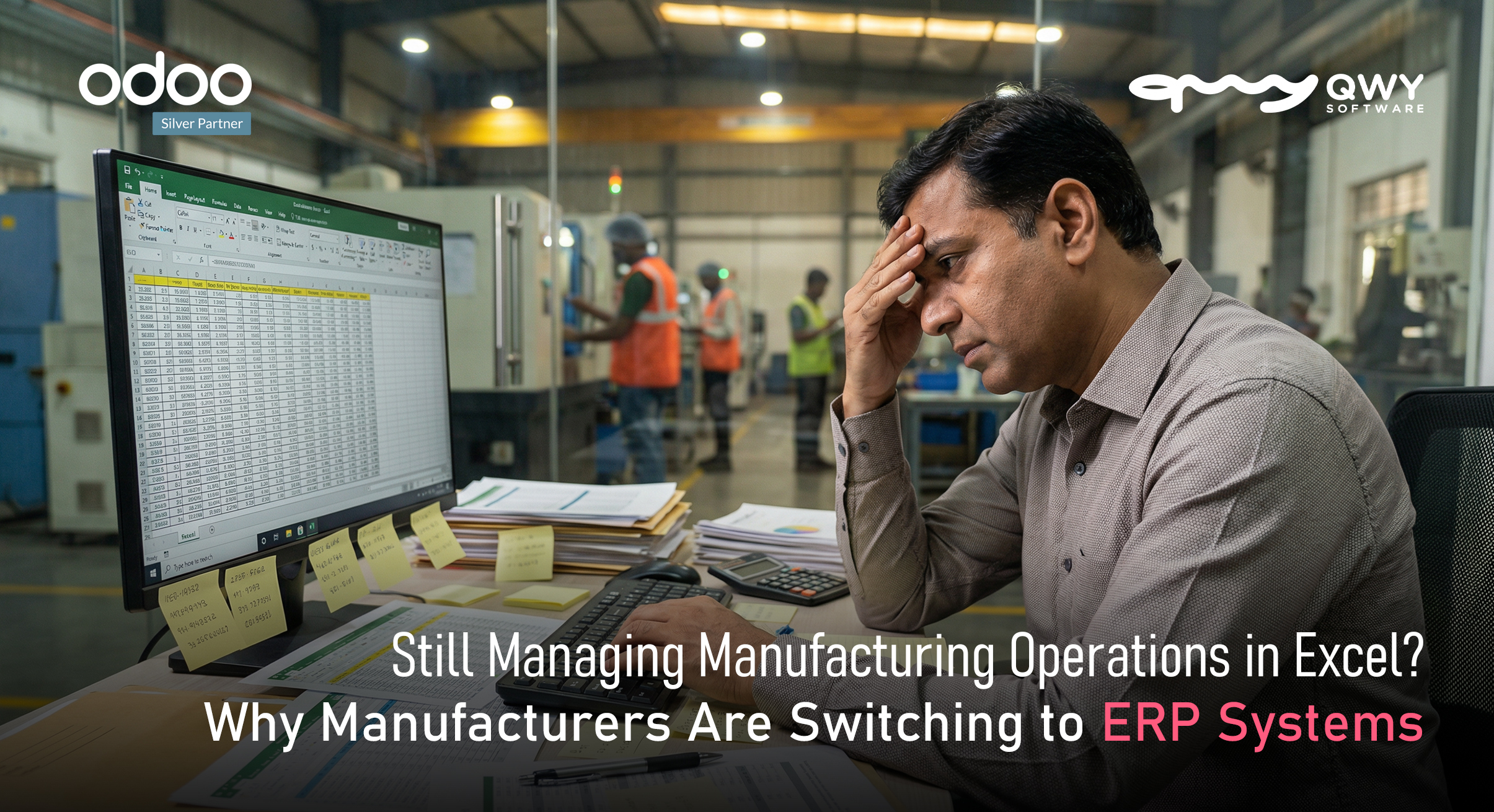
Many manufacturing businesses still rely on Excel spreadsheets to manage day-to-day operations whether it’s production planning, inventory tracking, purchase management, or even financial reporting.
And honestly, it makes sense.
Excel is familiar. It’s easy to start with. And for a small or growing business, it often feels like “good enough.”
But as operations expand, things begin to get complicated.
You start dealing with multiple spreadsheets across departments. Data needs to be updated manually. Teams depend on each other for the latest information. And suddenly, something as simple as checking stock or tracking production becomes time-consuming.
Over time, these small inefficiencies turn into major operational bottlenecks.
That’s why more manufacturers are now moving toward ERP systems because they offer a centralized, automated way to manage the entire business without the chaos of disconnected spreadsheets.
2. Why Excel Became the Go-To Tool for Manufacturing
Excel didn’t become popular by accident it solved real problems at the right time.
For many manufacturing businesses, especially in the early stages, Excel offered exactly what was needed:
- A simple way to organize data
- Low or no additional cost
- Flexibility to customize sheets as required
- No dependency on complex systems
It allowed businesses to move fast without worrying about software implementation or training.
But manufacturing operations don’t stay simple for long.
As businesses grow, processes expand across multiple areas production, procurement, inventory, sales, and finance. And managing all of this through spreadsheets starts to feel like trying to control a complex system with disconnected pieces.
That’s where the limitations begin to show.
3. The Major Limitations of Managing Manufacturing Operations in Excel
Lack of Real-Time Operational Visibility
One of the biggest challenges with Excel is that it doesn’t update itself.
Everything depends on manual input. So unless someone updates the data immediately, you’re always looking at information that may already be outdated.
In a fast-moving manufacturing environment, this lack of real-time visibility makes it difficult to:
- Track production progress
- Monitor stock levels
- Respond quickly to changes
And that delay can drectly impact efficiency.
High Risk of Data Errors
Manual processes always come with risk.
A small typo, a missed formula, or copying data incorrectly can lead to inaccurate reports. And when multiple teams are maintaining different versions of spreadsheets, it becomes difficult to know which one is actually correct.
Over time, these errors can affect planning, costing, and even customer commitments.
Disconnected Business Processes
In most manufacturing setups using Excel, each department works independently.
Production has its own sheet. Inventory has another. Procurement and accounts manage separate files.
But since these systems aren’t connected, teams have to constantly communicate and verify information manually.
This leads to delays, miscommunication, and inefficiencies that slow down the entire operation.
Inefficient Production Planning
Without automation, planning production becomes a challenge.
You may not always have accurate visibility into:
- Available raw materials
- Current stock levels
- Pending purchase orders
As a result, production schedules are often based on assumptions rather than real data, leading to delays or excess inventory.
Limited Scalability
What works for a small operation doesn’t always work for a growing business.
As the number of products, orders, and transactions increases, so does the number of spreadsheets.
Managing them becomes increasingly complex, and the chances of errors grow significantly.
At some point, Excel stops supporting growth and starts restricting it.
4. Why Modern Manufacturers Are Switching to ERP Systems
ERP (Enterprise Resource Planning) systems are designed to solve exactly these challenges.
Instead of managing different processes separately, ERP brings everything into a single, integrated platform.
This means:
- All departments work on the same system
- Data updates in real time
- Processes are automated and connected
With ERP, manufacturers can:
- Track production as it happens
- Maintain accurate inventory records
- Automate procurement based on demand
- Connect sales orders with production planning
- Monitor financial performance instantly
It’s not just about efficiency it’s about gaining complete control over operations.
5. Key Manufacturing Operations That ERP Systems Transform
ERP systems don’t just replace spreadsheets they transform how core operations function.
For example:
- Production Planning: Work orders can be scheduled, tracked, and adjusted in real time
- Procurement: Purchase decisions are based on actual production requirements
- Inventory Management: Stock levels are updated automatically across locations
- Sales Management: Orders are directly linked with production and delivery
- Financial Management: All operational data reflects in financial reports instantly
By connecting all these functions, ERP removes silos and creates a smooth flow of information across the business.
6. QWY IndustryERP: Integrated ERP for Manufacturing Businesses
To help manufacturers move beyond manual systems, QWY offers IndustryERP, a comprehensive ERP solution built on Odoo.
It is designed specifically for manufacturing environments, where multiple processes need to work together seamlessly.
Instead of using separate tools, IndustryERP connects Manufacturing, Purchase, Inventory, Sales, and Accounting into one unified system.
This creates a centralized ecosystem where data flows automatically between departments improving accuracy, coordination, and efficiency.
Manufacturing Management
The manufacturing module gives you complete control over production operations.
You can manage:
- Bills of Materials (BOM)
- Work orders and scheduling
- Shop floor activities
- Real-time production tracking
This ensures better planning, reduced delays, and improved productivity.
Purchase Management
Procurement becomes more strategic and less reactive.
With IndustryERP:
- Purchase orders can be automated
- Vendor information is centralized
- Procurement aligns with production needs
This helps ensure that materials are always available when required.
Inventory Management
Inventory management becomes more accurate and transparent.
You get:
- Real-time stock visibility
- Multi-warehouse tracking
- Automated replenishment
- Clear tracking of raw materials and finished goods
This reduces stock discrepancies and improves overall efficiency.
Sales Management
Sales operations are directly connected with inventory and production.
This allows:
- Better order tracking
- Accurate delivery timelines
- Improved customer communication
Sales teams can make commitments with confidence, knowing the data is reliable.
Accounting & Financial Management
Financial processes are fully integrated with operations.
Instead of manual data entry, you get:
- Automated invoicing
- Real-time expense tracking
- Accurate financial reports
- Profitability insights
This gives you a clear understanding of your business performance at any time.
7. How QWY Helps Manufacturers Implement ERP Successfully
Implementing an ERP system is not just a technical upgrade it’s a business transformation.
And this is where many companies struggle.
Because it’s not about simply installing software and expecting everything to work instantly. Every manufacturing business has its own processes, workflows, and challenges. If the ERP system doesn’t align with these, it can create more confusion instead of solving problems.
That’s why at QWY, the focus is always on understanding your business first then building the system around it.
We take a structured and practical approach to ERP implementation:
- ERP Implementation: We deploy Odoo-based ERP systems that are carefully configured to match your manufacturing operations. From production workflows to inventory structures, everything is set up with real-world usage in mind not just theoretical design.
- Custom ERP Development: No two manufacturing businesses are the same. That’s why we customize modules, workflows, and dashboards to reflect how your business actually operates. Whether it’s unique production processes or specific reporting needs, the system is tailored not forced.
- System Integration: Many manufacturers already use different tools, machines, or third-party systems. We ensure your ERP connects seamlessly with them, creating a smooth flow of data across your entire ecosystem.
- Ongoing ERP Support: ERP is not a one-time setup. As your business evolves, your system should evolve too. QWY provides continuous support, improvements, and optimization to make sure your ERP keeps delivering value over time.
The goal is simple: to help you move from disconnected spreadsheets to a fully integrated, efficient, and scalable digital system without disrupting your operations.
8. Signs Your Manufacturing Business Has Outgrown Excel
Sometimes, the biggest challenge is realizing that your current system is no longer working.
Many businesses continue using Excel simply because “it’s what we’ve always done.” But if you look closely, the signs are usually very clear.
For example:
- You frequently encounter inventory mismatches and spend time fixing them
- Your team struggles to track the real-time status of production
- Reports take hours or even days to prepare
- Different departments rely heavily on calls, messages, or meetings to confirm data
- You’re managing too many spreadsheets, and no one is sure which one is the latest
These are not just minor inconveniences.
They are indicators that your operations have become more complex than what spreadsheets can handle.
At this stage, continuing with Excel doesn’t just slow you down it limits your ability to grow, scale, and compete effectively.
Recognizing this early is the first step toward building a more efficient system.
9. Transitioning from Excel to ERP: What Manufacturers Should Know
Moving from Excel to an ERP system might feel like a big leap and that’s completely normal.
But when done the right way, it’s not as complicated as it seems.
In fact, the transition is less about technology and more about clarity and structure.
It typically starts with understanding your current challenges:
- Where are delays happening?
- Which processes are manual and repetitive?
- Where do errors occur most often?
From there, your workflows are mapped in a structured way. This helps in designing an ERP system that actually fits your business rather than forcing you to change everything overnight.
The next step is selecting the right ERP platform (like Odoo) and implementing it with the right partner.
At QWY Software, we ensure that:
- The system is implemented in phases to avoid disruption
- Your team is properly trained and comfortable using it
- Processes are optimized gradually for better adoption
Because at the end of the day, ERP success is not just about the system it’s about how well your team uses it.
With the right guidance, this transition becomes a smooth upgrade rather than a difficult shift.
10. Conclusion: Building a Smarter Manufacturing Ecosystem
Excel may have helped you build your operations but it’s not designed to support long-term growth in a complex manufacturing environment.
As your business expands, you need more than just data tracking.
You need:
- Real-time visibility into operations
- Automated and connected workflows
- Better coordination across departments
- Accurate insights for faster decision-making
This is exactly what ERP systems are built for.
They don’t just organize your data they transform how your entire business functions.
With QWY IndustryERP powered by Odoo, manufacturers can move away from manual, disconnected processes and step into a more structured, efficient, and scalable system.
It’s not just about replacing spreadsheets.
It’s about building a smarter manufacturing ecosystem one that supports growth, improves efficiency, and prepares your business for the future.